Morella
Morella is a walled medieval city 2h10 from Valencia — 13th-century castle, 2.5 km of intact city walls, dinosaur fossil museum and no tourist traps.
Valencia: excursion to Morella and Peñíscola with tickets
Duration: 11 hours
Quick facts
- Distance from Valencia
- 190 km north-west
- Travel time
- ~2h10 by car (A-23 north, then CV-15); no practical public transport option
- Getting there
- Car required; bus connections exist but journey is 3h+ with changes
- Best for
- Medieval walled city, 13th-century castle, intact walls circuit walk, winter truffle market
- Don't miss
- The castle (Castillo de Morella), city walls circuit, Basílica de Santa María la Mayor
| Where | 190 km north-west of Valencia, Castellón interior |
| Time needed | Full day; overnight recommended |
| Getting there | Car required, ~2h10 |
| Cost | Castle and basilica prices on the official Morella tourism website; overnight from ~€50–100 |
| Best time | March–June, September–November; winter for the truffle market |
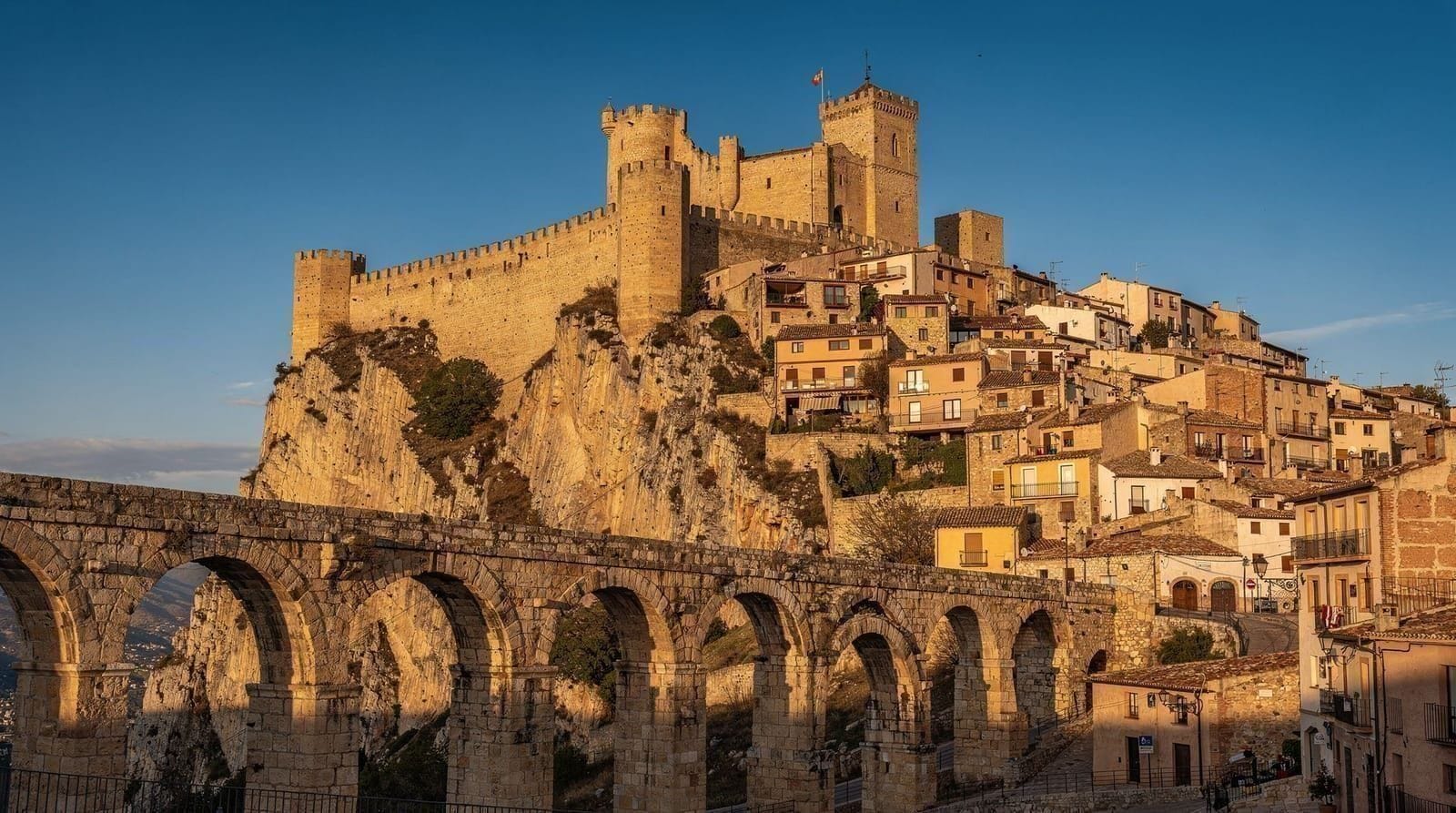
Morella is the most completely preserved medieval walled city in the Valencia region, and arguably one of the best in Spain. At 1,004 metres above sea level, enclosed by 2.5 kilometres of Gothic-era city walls, and crowned by a castle that was already ancient when the Aragonese took it in 1232, Morella has the appearance of a place largely untouched since the 15th century. That’s partly true: its population has shrunk from a medieval peak of 10,000 to around 2,500 today, which explains the silence in its streets compared with more tourism-saturated medieval towns.
The honest caveat: it is 2 hours 10 minutes from Valencia by car. For a day trip, you’ll be spending 4+ hours driving. Most visitors who see Morella at its best stay overnight — the town empties of day-trippers by 17:00 and the evening light on the castle walls is extraordinary.
Getting to Morella from Valencia
By car: Take the A-23 north (toward Sagunto, then Segorbe, then Teruel) to the junction at Los Hostales, then follow the CV-15 northwest to Morella. The CV-15 is a winding mountain road for the final 40 km — beautiful but slow. Allow 2 hours 10 minutes minimum; add 30 minutes if there’s Valencia ring road traffic. There is no motorway toll on this route.
By bus: An Autocares Morellana bus runs from Castellón (not Valencia) to Morella once or twice daily. From Valencia, you would need to take a Renfe train to Castellón first (~50 min, €7–10), then wait for the Morella connection. Total journey time: 3 hours minimum, with poor return timing for a day trip. Practically, this is not a useful option for Valencia visitors on a day trip budget.
Organised day trips from Valencia that combine Morella with Peñíscola are the best public-transport-free option:
Valencia: excursion to Morella and Peñíscola with tickets — an 11-hour tour visiting both towns, with entrance tickets included. Intensive but the only practical no-car option for seeing both.
Private Morella and Peñíscola full-day trip from Valencia — a private option for small groups or families wanting a customised pace.
The castle (Castillo de Morella)
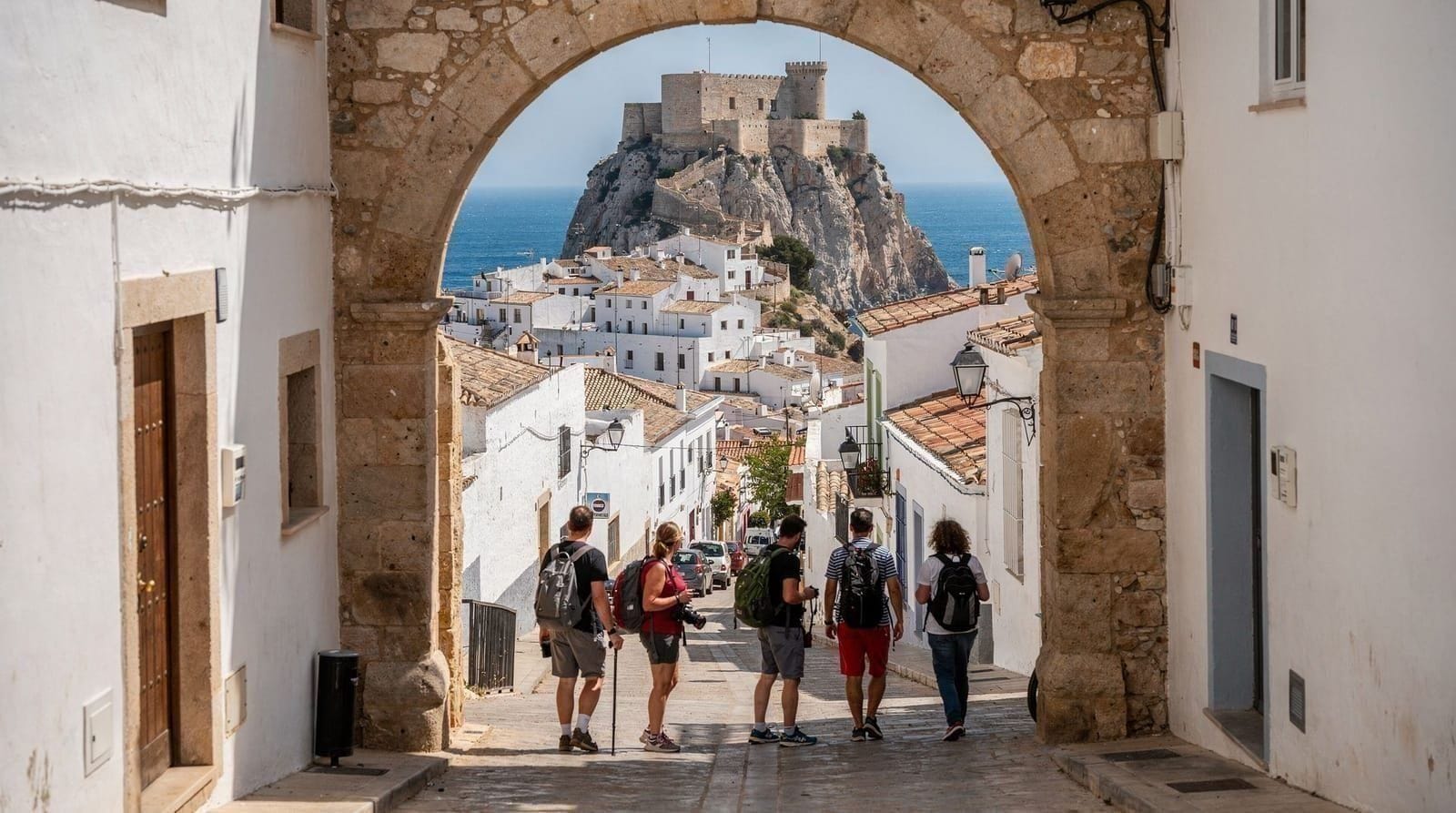
The castle sits at the highest point of the rock (1,031 metres), accessed from the town via a single path through the Puerta de San Miguel. The original Iberian and Roman fortifications were rebuilt by the Moors, then taken by Aragonese King Jaume I in 1232 — a feat he described in his chronicle as essential to controlling the whole of the Maestrat region.
The current castle is largely 13th–14th century in construction, with additions and repairs through the 17th century. It contains the ruins of two churches (one Gothic, one Romanesque), a cistern, several towers, and defensive walls within walls. The castle is a genuine ruin — not reconstructed — which gives it more archaeological character than Xàtiva’s more-visited fortress.
Check the official Morella tourism website for the current entry price and opening hours. The ascent from the town gate to the highest tower takes 20–25 minutes and involves 400 steps total. Views from the top extend across the entire Castellón interior, to the sea on clear days (60 km east), and north toward the Aragonese border.
Practical notes: the castle path is exposed and there are no barriers on the upper sections. Bring water; there is no refreshment service inside. The castle closes in wet or icy conditions — check the Morella tourist office website before driving up in winter.
The city walls
Morella’s walls are continuous for 2.5 km and were built primarily in the 13th and 14th centuries, reinforced with several large round towers. You can walk the full circuit on foot — the wall walk path is mostly accessible (some sections require 5–10 minutes on rough ground), and takes approximately 60–75 minutes. The views from different sections of the wall provide different perspectives: the south wall looks over the gorge and valley below; the north wall faces the castle rock more directly.
Six gates survive in various states: Portal de Sant Miquel (the main pedestrian entrance), Portal dels Estudis, and four others, some now blocked or partially collapsed. Each gate has its own character; the Portal de Sant Miquel is the most photographed.
The Basílica de Santa María la Mayor
The basilica at the town’s centre is a Gothic church begun in the 14th century and featuring two Baroque-era spiral staircases inside that are among the more unusual architectural elements in the region. The choir gallery (accessible via one of the staircases) contains 15th-century carved choir stalls. For current entry prices, see the official Morella tourism website.
The church clock tower is the most prominent vertical element in Morella’s skyline when viewed from outside the walls. The bells ring at unexpected volumes — a mild shock if you’re in the church when they sound.
Truffle market and winter visits
Morella is in the heart of the Spanish black truffle (Tuber melanosporum) growing area. The winter truffle market (Mercat de la Tòfona) takes place in late January or early February — several days of truffle sales, tasting menus at local restaurants, and truffle-hunting demonstrations in the surrounding hills. This is when Morella gets significant national and international press attention — early booking for the town’s limited accommodation is essential.
Outside the truffle market, winter visits (November–February) have the advantage of near-solitude. The walls and castle are at their most atmospheric in light snow or frost. Some restaurants and casas rurales close for the quietest weeks (typically January), but the main attractions remain open.
Where to eat in Morella
Morella has genuine local gastronomy worth seeking out. The local black truffle appears on menus from November through February. Other local specialities include carnisseria de Morella (Morella cured meats — a specific local style of embutidos) and various lamb dishes from the surrounding hill farms.
Reliable restaurants:
- Restaurante Mesón del Pastor (Cuesta Jovani): solid local cuisine, truffle dishes in season, menú del día €15–18. Reservations recommended on weekends.
- Casa Roque (Cuesta San Juan): one of Morella’s better-regarded options, slightly higher price point (€25–35/person), strong wine list featuring local Castellón producers.
- Avoid the restaurants immediately outside the main gate — they cater primarily to day-trippers and price accordingly.
For the Morella day trip guide and the Peñíscola–Morella two-day itinerary, see the dedicated guides. Morella combines naturally with Peñíscola for a north-coast Castellón circuit.
Practical information
- Parking: Large free car park at the base of the town (Plaça de Sant Francesc area) — do not attempt to drive into the old town
- Castle hours and prices: see the official Morella tourism website; closed in heavy snow/ice
- Walls walk: Free, always accessible; 75-minute circuit
- Tourist office: Portal de Sant Miquel area — can advise on current opening hours and seasonal closures
- Overnight accommodation: Hotel Cardinal Ram (historic 15th-century building, 3-star equivalent, €70–100/night); several casas rurales outside town walls (€50–80/night)
Morella through the seasons
| Season | Atmosphere | Notes |
|---|---|---|
| Spring (Mar–Jun) | Green hills, pleasant walking weather | Good balance of open services and manageable crowds |
| Summer (Jul–Aug) | Busiest with domestic tourism | Still calmer than the coast; book accommodation ahead |
| Autumn (Sep–Oct) | Harvest atmosphere, quieter streets | One of the best windows for photography |
| Winter (Nov–Feb) | Near-empty, atmospheric, possible snow | Truffle market late Jan/early Feb draws a national crowd |
Planning the trip around Morella
Because Morella is a car trip, it helps to decide early how you will get there. Our guide to car rental for day trips covers the practicalities of picking up a vehicle in the city, while day trips without a car is the honest read on what you can and cannot reach by public transport — Morella firmly belongs in the second category.
If you are still deciding between inland destinations, it is worth comparing Morella with other mountain-and-village outings. Bocairent is another medieval town with a strong sense of place, and Montanejos pairs hill scenery with a very different, outdoors-focused feel. For a castle that is easier to reach, Xàtiva is the more convenient comparison.
Think about the season before you commit. The best time to visit Valencia guide helps you match the weather to your dates, and Valencia in winter is useful if the truffle market or a frosty, quiet Morella is what draws you. Whatever the month, a menú del día is a good way to understand how lunch works in Spain before you sit down in a mountain restaurant.
Why an overnight changes the experience
Morella is one of the few Valencia-region day trips where staying overnight genuinely transforms the visit rather than just adding convenience. Day-trippers arrive by mid-morning and leave by late afternoon; by 17:00 the coach groups have gone and the town empties out. What’s left is the version of Morella locals actually live in — quiet lanes, the castle silhouette lit by the setting sun, and restaurants that shift from tourist-lunch mode to a calmer dinner service. If your schedule allows even one night at a place like Hotel Cardinal Ram or one of the casas rurales just outside the walls, the difference from a rushed day trip is considerable.
Valencia: excursion to Morella and Peñíscola with tickets — the standard no-car option for seeing both towns.
Frequently asked questions about Morella
Is Morella worth 2 hours driving from Valencia?
For travellers specifically interested in medieval history, walled cities and unspoiled Spanish interior landscapes, yes without qualification. For beach-focused visitors or those with limited time, the drive time makes it a harder sell than closer day trips. It is the most architecturally intact medieval city within reasonable reach of Valencia — a claim that holds up against considerable competition.
Can I visit Morella without a car?
Practically, no — not as a day trip from Valencia. Bus connections require changing in Castellón with poor timing. The most realistic no-car option is an organised day tour that combines Morella with Peñíscola (see above). If staying overnight, you can arrive by bus from Castellón with better planning.
What is the best time of year to visit Morella?
Spring (April–June): pleasant weather, green hills, full services. Autumn (September–October): harvest atmosphere, lower crowds. Winter (November–January): most atmospheric and near-empty, but some services close and weather can include snow. August: busy with Spanish domestic tourists; the town handles it better than Peñíscola, but still more crowded than shoulder months.
How many people live in Morella?
Approximately 2,500 permanent residents, down from a medieval peak of around 10,000. The depopulation of rural Castellón’s interior has been significant — many houses in the old town are used only as holiday homes.
Are there dinosaur fossils near Morella?
Yes. The Morella area is one of Spain’s most significant dinosaur fossil sites. The Museu de les Ciències de Morella (Paleofest museum) in the town covers the regional paleontology. Fossils of the sauropod Europatitan eastwoodi and other Early Cretaceous species have been found in the hills nearby. The museum is small but genuinely informative; check the official Morella tourism website for the current entry price.
Does Morella get snow?
Yes — at 1,004 metres elevation, Morella typically sees snowfall several times per winter, usually January–February. The castle may close during or after heavy snowfall. Snow doesn’t deter the town’s tourism — some visitors specifically come for the winter atmosphere — but always check conditions before a winter day trip drive.
How does Morella compare to Guadalest for a “medieval village” day trip?
They’re different in scale and feel. Morella is a full walled city with 2.5 km of intact walls and 2,500 residents — genuinely lived-in rather than a single picturesque core. Guadalest is a much smaller hilltop settlement with a dramatic reservoir view but a higher density of souvenir shops relative to its size. Morella is the more substantial, less commercial experience; Guadalest is easier to combine with a beach day near Alicante.
Is Morella worth combining with Peñíscola over two days?
Yes — it’s the most natural pairing for this part of Castellón. Peñíscola gives you the coast, the castle-on-a-rock setting and the beaches; Morella gives you the mountain interior and the walled medieval city. The Peñíscola–Morella itinerary lays out a realistic two-day self-drive version with an overnight in Morella.
Top experiences
Bookable activities with verified prices and instant confirmation on GetYourGuide.