Running in the Turia Gardens: routes, distances and tips
Valencia: parks private tour on bicycle, e-bike or e-step
Is the Turia Gardens a good place to run in Valencia?
Yes — one of the best urban running routes in Spain. The path is 8.5 km long, entirely car-free, mostly flat, and well-maintained. It is used by hundreds of runners daily. Distance markers appear every kilometre from the western end.
The Turia Gardens running path is Valencia’s equivalent of New York’s Central Park running loop or Paris’s Canal Saint-Martin — an urban route with enough distance to sustain proper training, enough variety to prevent boredom, and enough other runners to feel part of a community. The difference is that the Turia path is entirely linear (not a loop), which requires slightly different planning, but the 8.5 km straight provides multiple entry points and distance options.
| Where | Former Turia riverbed, Bioparc to City of Arts and Sciences |
| Distance | 8.5 km main path; 12–13 km with beach extension |
| Cost | Free |
| Surface | Tarmac and compacted track, road shoes fine |
| Best time | 07:00–09:00 year-round; evenings spring–autumn |
The route and distances
The Turia Gardens path follows the former bed of the Turia river, running east-west through the city. It connects Bioparc Valencia in the west to the Ciudad de las Artes y las Ciencias in the east, a distance of 8.5 km.
Distance markers: White kilometre markers appear on the path starting at the western end. By the time you reach the City of Arts, you are at km 8 or km 9 depending on which count the path is using. These are useful reference points for pacing and turning decisions.
Common running sections:
Western section (km 0–3): From Bioparc to the Palau de la Música. Wider, quieter, and more parklike. Used more by local residents than tourists. Good for longer intervals with fewer interruptions.
Central section (km 3–6): Passes Torres Serranos gate and the main recreational zone of the gardens. More crowded in the morning, with cyclists, dog walkers, and children. Beautiful backdrop (the medieval gate overhead, mature trees) but requires weaving at peak times.
Eastern section (km 6–8.5): From near the Natural Sciences Museum through to the City of Arts. Quieter again, architecturally striking, ends at the Oceanogràfic area.
Beach extension (km 8.5–12.5): The path continues from the City of Arts to La Malvarrosa beach, transitioning from the gardens to urban cycle paths and then to the beach promenade. This extension adds 4 km each way. Running to the beach and back from the city centre creates a 20+ km long run if you use the full path.
Starting points and access
Bioparc end (western): Accessible from Avinguda de Pío Baroja. Good parking, and the entrance to the gardens here is spacious. Few tourists at this end — primarily local runners and cyclists.
Torres Serranos (central): The most convenient starting point for visitors staying in the old town. The medieval gate is directly above the path — a striking landmark for photos and an obvious orientation point. Distance to the City of Arts from here: approximately 3.5 km.
Hemisfèric / City of Arts (eastern): Starting from the east and running west allows you to see the City of Arts architecture at the beginning rather than the end of your run, which gives better light in the morning.
Running conditions throughout the day
Early morning (7:00–9:00): The best time year-round. Light is excellent for running east (toward the City of Arts) in the morning — you run into rising sun in summer but have the buildings lit beautifully. Temperature is comfortable even in July. Mainly other runners and cyclists, very few tourists.
Mid-morning (9:00–11:00): Still good in spring and autumn. In summer, temperatures rise quickly — by 10:30 in July it is already 28–30°C and direct sun in the exposed sections is significant.
Midday and afternoon: Not advisable in summer. The temperature on the path between the open sections regularly exceeds 35°C. Even experienced runners in hot climates should avoid this window June–August.
Evening (18:00–20:00): Popular and pleasant spring through autumn. The gardens fill with after-work runners, cyclists, and walkers. The eastern section in low light is particularly attractive. Sunset views toward the Hemisfèric are a frequently photographed reward.
Night (20:00–22:00): The main path is lit sufficiently for running. The western section has some less-lit stretches — familiar after a few runs but not advisable for a first night run in an unknown city.
Water and facilities
Drinking fountains: Spaced approximately every 1.5–2 km in the central and western sections. Less frequent in the eastern section. All are functional in spring and summer; some are turned off in winter. Do not rely on fountain availability for runs over 6 km in warm weather — carry at least 500 ml.
Toilets: Public toilets are available at Torres Serranos, at the Gulliver Park area, at the Science Museum, and at the Oceanogràfic. Not ideally spaced for a long run but manageable with planning.
Cafés: Kiosk cafés are available in the central section from around 8:00 in summer. Some serve energy drinks and fruit. Not a primary energy source but useful in emergencies.
Running etiquette on the Turia path
The path is shared with cyclists, skateboarders, and pedestrians. A few conventions apply:
- Keep right: The left side is generally for faster-moving cyclists. Running on the right avoids most conflicts.
- Headphones and awareness: Running with headphones is common, but keeping at least one ear open helps with cyclists approaching from behind (particularly e-bikes, which are silent until very close).
- Dog leads: Dogs are permitted but should be leashed in the central sections. The western section is more relaxed about this — be aware of off-lead dogs.
- Groups: Running groups are common on weekend mornings. They tend to occupy width — when meeting a group head-on, move to the far right.
Planning a run as a visitor
Because the path is a straight line rather than a loop, the practical question is always how you get back. The simplest answer is the out-and-back: pick a landmark, run to it, and turn around. Torres Serranos makes a natural turning point if you start from the City of Arts side, and the City of Arts and Sciences guide is useful if you want to understand what you are running past at the eastern end. The Turia Gardens overview gives the wider picture of how the old riverbed became a park, which helps explain why the path is so continuous and so free of road crossings.
If you would rather run one way and ride back, the city’s public transport is the easy option. The metro and EMT guide explains how to get from a station near the gardens back to your starting point without detouring through the centre. Another approach is to run one direction and walk the return leg, treating the second half as a cool-down and a chance to look at the things you ignored while pacing.
Matching the run to your level
- Short and easy: a few kilometres from the old town entry and back. Good for a first morning, a shake-out run before a flight, or a gentle day after a long one.
- Steady middle distance: a section of the central stretch, using the white kilometre markers to check your pace without a watch.
- Long run: the full length of the gardens, with or without the beach extension. Carry water, tell someone your plan, and decide beforehand where you will turn around.
The flat profile is the main reason the route suits all three. There are no climbs to manage, so effort stays even and pacing mistakes are easy to correct. Intervals work well in the quieter western stretch, where you can mark a start and end point by a tree or a bench and repeat it.
What you pass along the way
One of the pleasures of the route is that it works as a moving tour. Heading east you move from the zoo-side parkland of the western end towards the Bioparc family guide area, then through the more urban central stretch, and finally into the monumental eastern end.
- Torres Serranos: the medieval gate overhead in the central section. The Serranos and Quart towers guide explains its history if you want to return and climb it after your run.
- Gulliver Park: the giant figure beside the path is a landmark runners use for orientation. See the Gulliver Park guide if you are travelling with children who might prefer to meet you here.
- Science Museum, Hemisfèric and Oceanogràfic: the eastern end is dominated by the Science Museum, the Hemisfèric and the Oceanogràfic. If you plan to visit one, a morning run that finishes outside is a good way to scout the entrances and queues before you come back properly.
Running past all of this early, with the paths nearly empty, is a very different experience from crossing the same area at midday with the visitors. It is also a cheap way to decide which attractions are worth your time.
After the run
Finishing near the eastern end puts you close to the cafés and open spaces around the City of Arts, and from there the beach is within reach by the extension path or by public transport. If you ran to the sea, Malvarrosa beach is a fitting place to stop: cool down on the sand, stretch, and have a proper breakfast before heading back. The nearby Cabanyal guide covers where to eat in the neighbourhood behind the beach.
Basic recovery habits apply as anywhere: drink, stretch while your muscles are still warm, and avoid sitting in direct sun in your damp running kit. In summer especially, take a lighter route back and save the heavier sightseeing for the evening.
Seasonal running in Valencia
Spring (March–May): Ideal. Temperatures 15–25°C, long daylight hours, the gardens blooming. The best season for running the full route.
Summer (June–September): Manageable with strict morning or evening scheduling. The beach extension run (gardens to sea and back) is excellent at 7:00 in summer — cool air off the sea, empty streets, the city waking up.
Autumn (October–November): Very good. Temperatures drop to 18–24°C. October mornings have excellent running quality and the gardens turn from summer green to autumn gold in the western sections.
Winter (December–February): Cool but rarely cold (8–15°C). The path is quieter. Very occasionally foggy near the eastern sections (the drained riverbed creates a slight inversion in cold still air). The Marathon de Valencia runs in early December and is one of the fastest marathons in Europe — partly because of the flat Turia route used in the course.
Seasons at a glance
| Season | Temp range | Running quality | Notes |
|---|---|---|---|
| Spring (Mar–May) | 15–25°C | Ideal | Best all-round season, gardens blooming |
| Summer (Jun–Sep) | Hot midday | Manageable | Morning or evening only |
| Autumn (Oct–Nov) | 18–24°C | Very good | Excellent light, cooler mornings |
| Winter (Dec–Feb) | 8–15°C | Good | Quieter path; Marathon de Valencia in December |
Renting a bike instead, or combining both
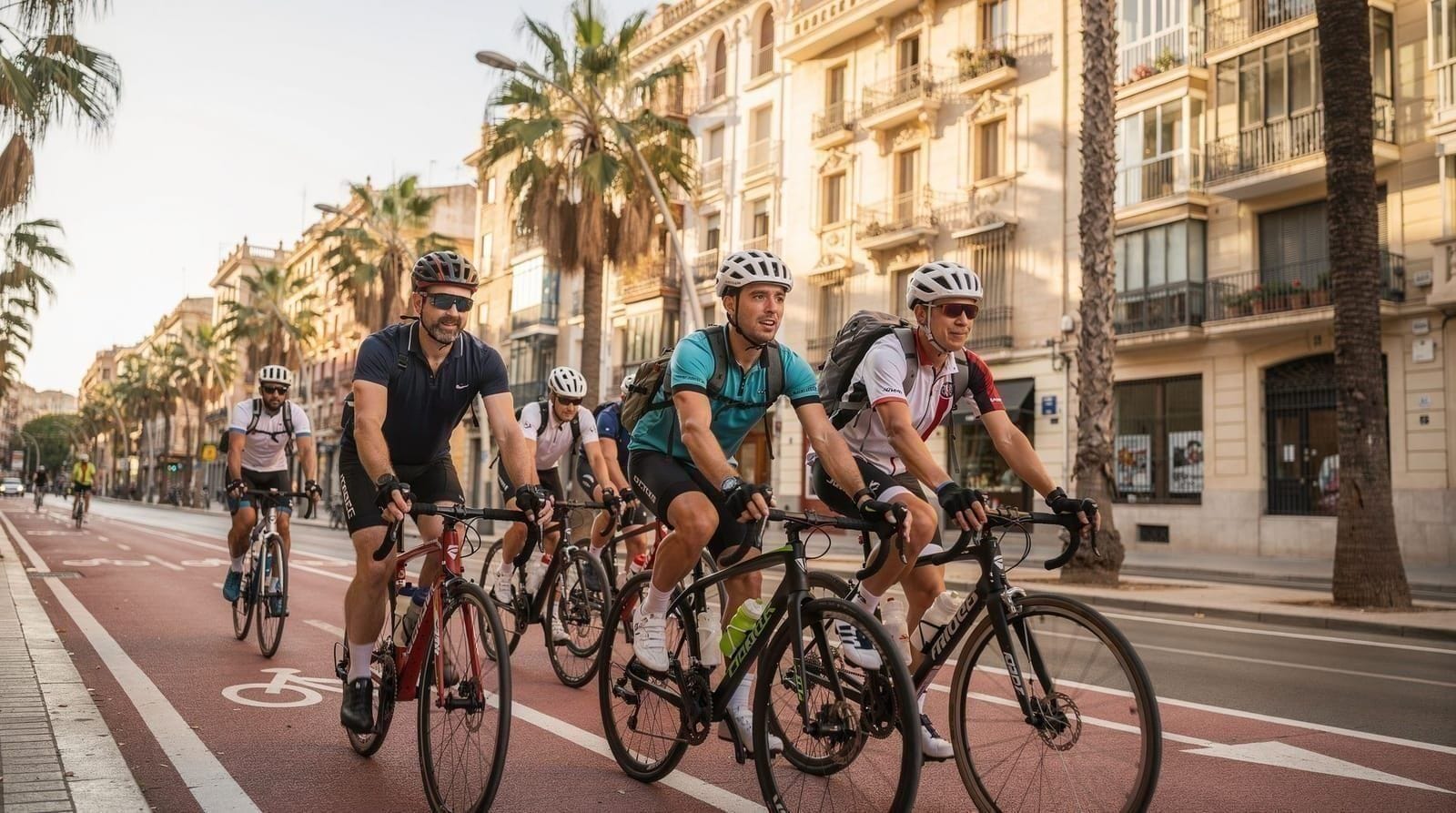
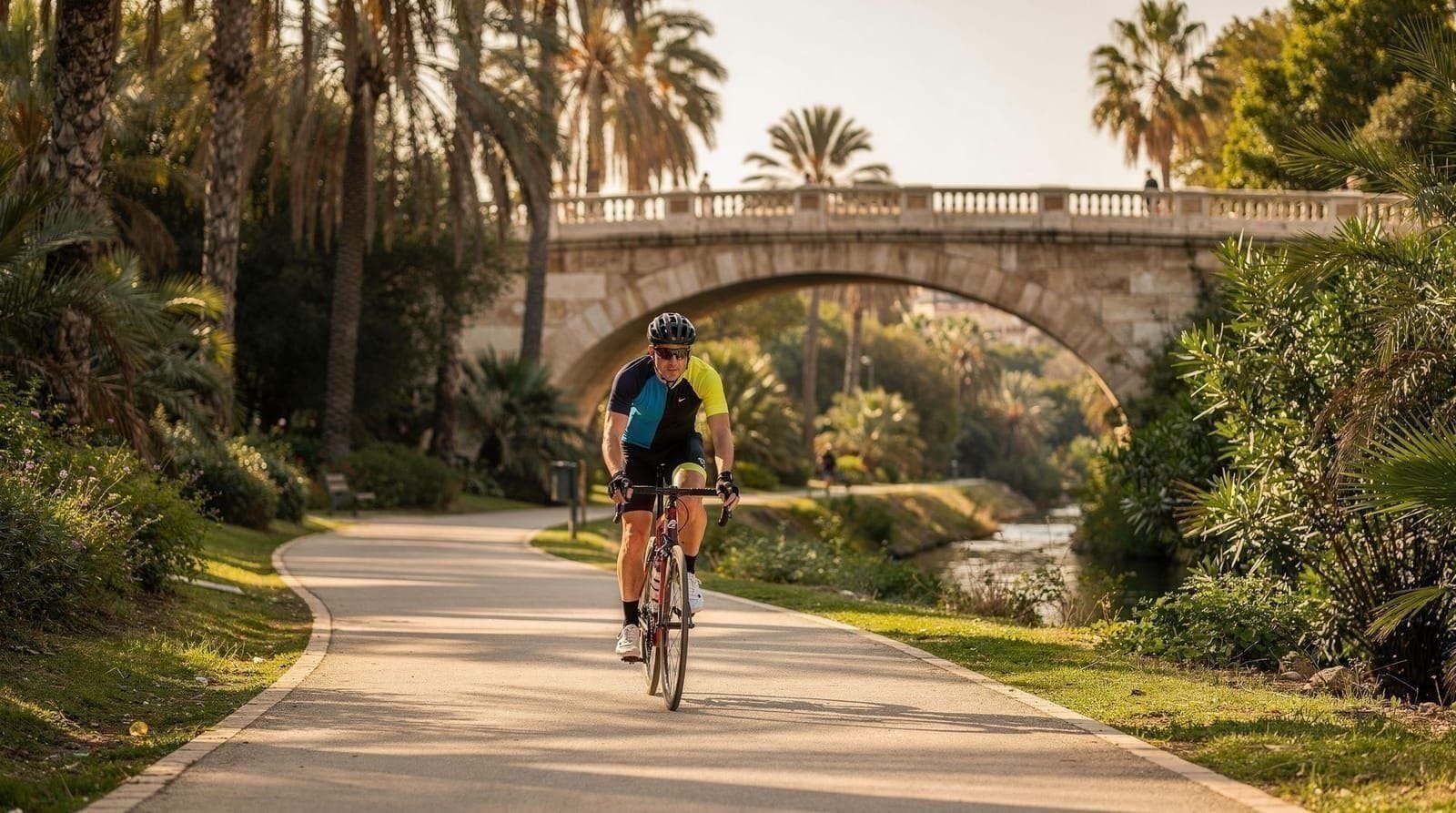
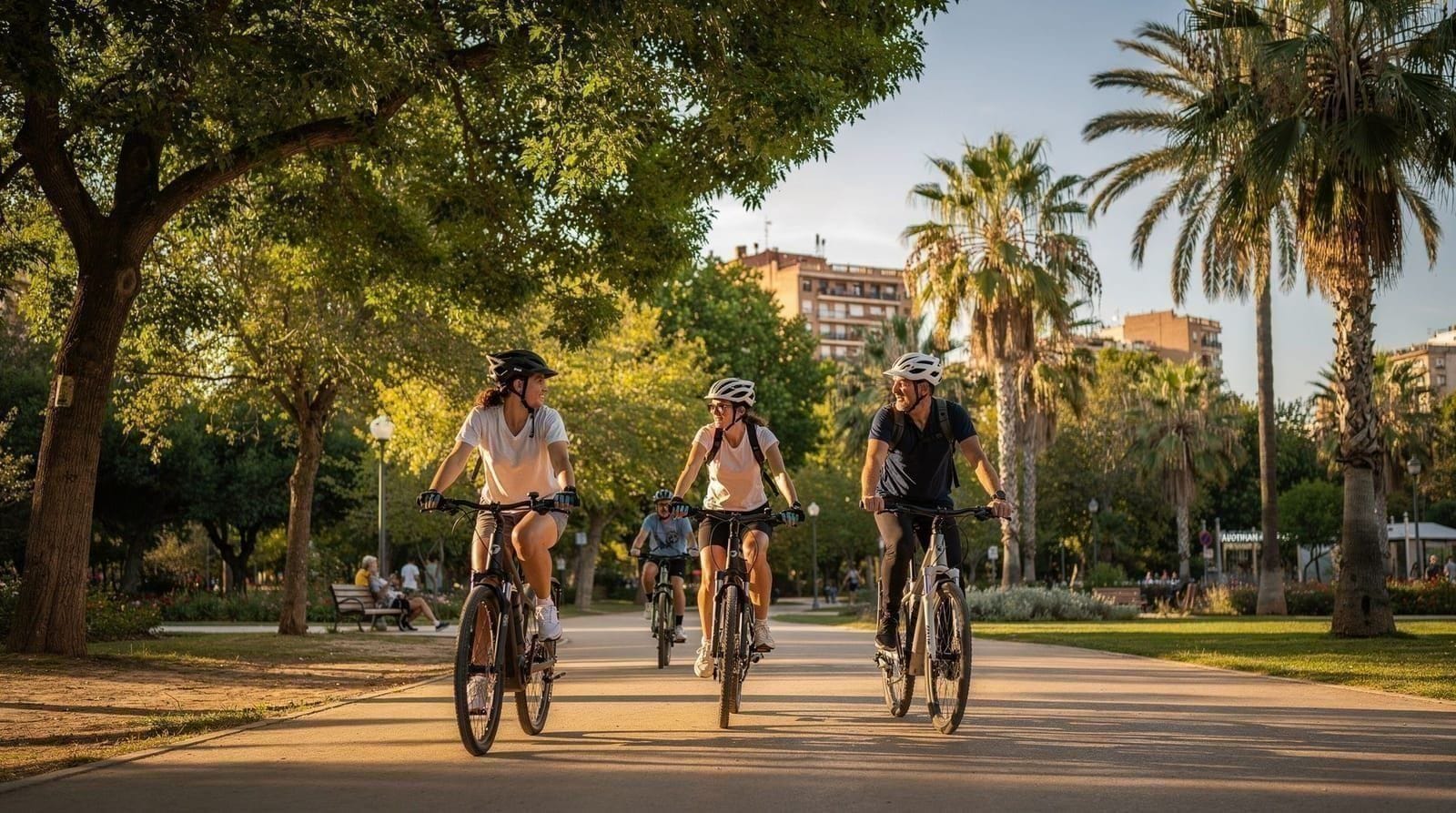
Not every visitor wants to run 8 km on holiday, and the Turia path works just as well by bike if you’d rather cover more ground with less effort. A guided e-bike route through the gardens is a practical way to see the same landmarks — Torres Serranos, the City of Arts, Gulliver Park — without the training commitment:
 parks private tour on bicycle, e-bike or e-stepCheck availability
If you prefer a group format with a guide explaining the park as you go, a guided bike tour of the Turia park covers the same corridor at an easier pace, and works well as a rest-day alternative to a run.
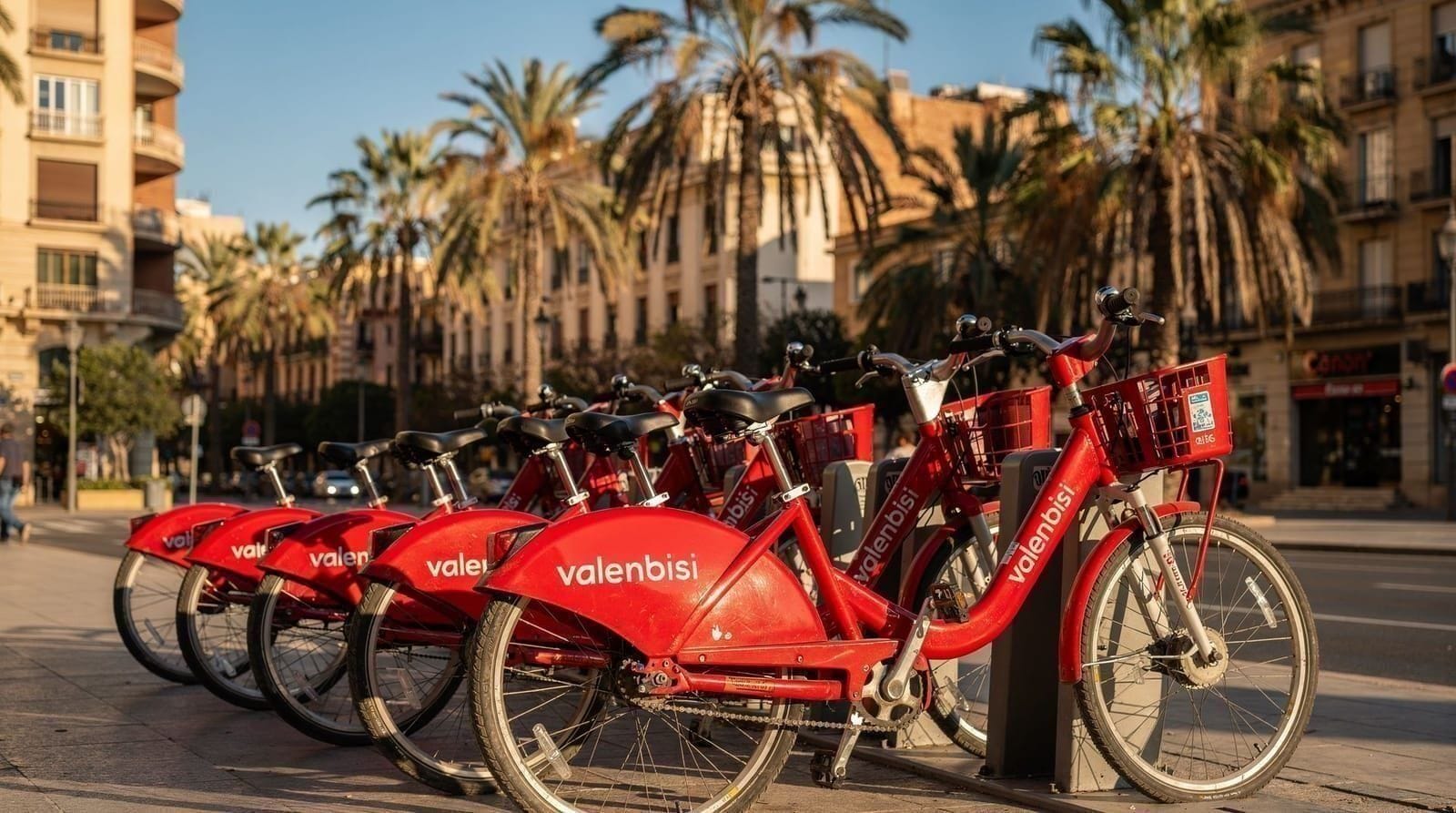
For self-guided cycling, the Valenbisi bike-share guide covers rental logistics if you’d rather ride the route yourself on a different day than you run it.
Choosing when to visit as a runner
If running is a main reason for your trip, timing matters more than anything else. The best time to visit Valencia guide covers the overall calendar, while the Valencia in summer and Valencia in autumn guides show what those seasons feel like on the ground. Spring and autumn give the most comfortable mornings and evenings, while summer rewards anyone willing to start early.
Combining running with a Valencia visit
For visiting runners, the Turia route is best experienced early on the first morning — before jet lag or schedule pressure sets in. A 5–8 km run from the old town entry to the City of Arts and back gives an excellent orientation to the city’s layout and scale. You pass the main cultural landmarks without stopping for them, which means you know where everything is when you visit properly later.
For visitors who want to explore the gardens without running, the Turia by bike guide covers the cycling route in detail. For the broader natural park context, see the Turia Natural Park guide.
Frequently asked questions about Running in the Turia Gardens
How long is the Turia Gardens running path?
The main path runs 8.5 km from Bioparc in the west to near Ciudad de las Artes y las Ciencias in the east. Extended with the beach approach path, total distance is approximately 12–13 km. Most runners use sections of 5–10 km rather than the full length.What is the surface like for running in the Turia Gardens?
Mostly smooth tarmac and compacted track. Some sections have rubberised running track. The surface is comfortable for road running shoes throughout. No trail shoes required.When should you run in the Turia Gardens in summer?
Before 9:00 or after 20:00. The path between the Hemisfèric and Gulliver Park is exposed to direct sun for much of the day. In July and August, running between 10:00 and 18:00 is hot (34–37°C surface temperature) and inadvisable.Where can you get water while running the Turia route?
Water fountains are spaced approximately every 1.5–2 km along the path. They are reliable in the main sections. The eastern section near the City of Arts has fewer fountains — carry water for any run over 6 km in warm weather.Are there organised running clubs or events in the Turia Gardens?
Yes. The 10K Valencia run and several other city races use the Turia as part of their route. Running clubs meet at various points along the path on weekend mornings. The Marathon de Valencia (December) partially uses the gardens.
Top experiences
Bookable activities with verified prices and instant confirmation on GetYourGuide.