Modernisme in Valencia: the art nouveau buildings guide
Valencia: hidden tour of Eixample, Cánovas and Ruzafa
What are the best Modernista buildings to see in Valencia?
The top three are: Mercado Central (1928, Francisco Guardia — the largest working market with a Modernista iron and tile structure), Mercado Colón (1916, Francisco Mora — a converted market now housing an upscale food hall), and Estació del Nord (1917, Demetrio Ribes — Valencia's main railway station with Valencian ceramics and Art Nouveau metalwork). All are in the city centre within 15 minutes' walk of each other.
Valencia’s Modernista architecture occupies a different position in the cultural conversation than Barcelona’s. The Catalan Modernisme of Gaudí and his contemporaries is world-famous; Valencia’s parallel tradition is largely unknown outside Spain. This is partly a matter of scale — Barcelona’s buildings are more ambitious and more numerous — but also a matter of visibility: Valencia’s best Modernista structures are working public buildings that function as market, station, and food hall rather than monuments preserved specifically for heritage tourism.
| Where | Mercado Central, Mercado Colón, Estació del Nord — all within 15 min walk |
| Cost | Free to enter all three; Mercado Central food purchases extra |
| Time needed | 2–3 hours for the full circuit |
| Getting there | Xàtiva metro/station area is the natural starting point |
| Best time | Weekday mornings, before 15:00 when the Mercado Central closes |
The context: Valencian Modernisme
The Modernisme movement — called Art Nouveau in France, Jugendstil in Germany, Liberty in Italy, and Modernisme in Catalonia and Valencia — was an architectural and design movement of the period 1890–1930 characterised by organic forms, elaborate decoration, integration of the crafts (ceramics, ironwork, stained glass) into architecture, and a rejection of historicist revivalism.
In Valencia, Modernisme was adopted enthusiastically and applied primarily to public buildings and bourgeois residential architecture. The movement arrived slightly later than in Barcelona and with a distinctly Valencian character: where Catalan Modernisme used ceramics in abstract structural patterns (Gaudí’s trencadís), Valencian Modernisme tended toward figurative ceramics — oranges, lemons, flowers, and human figures that celebrated the region’s agricultural and artistic identity.
The three buildings most worth seeing — Mercado Central, Mercado Colón, and Estació del Nord — were all built or completed between 1916 and 1928, at the end of the Modernista period. They represent the mature flowering of the style in Valencia.
Mercado Central (1928)
Architect: Francisco Guardia Vial, with contributions from Alejandro Soler March
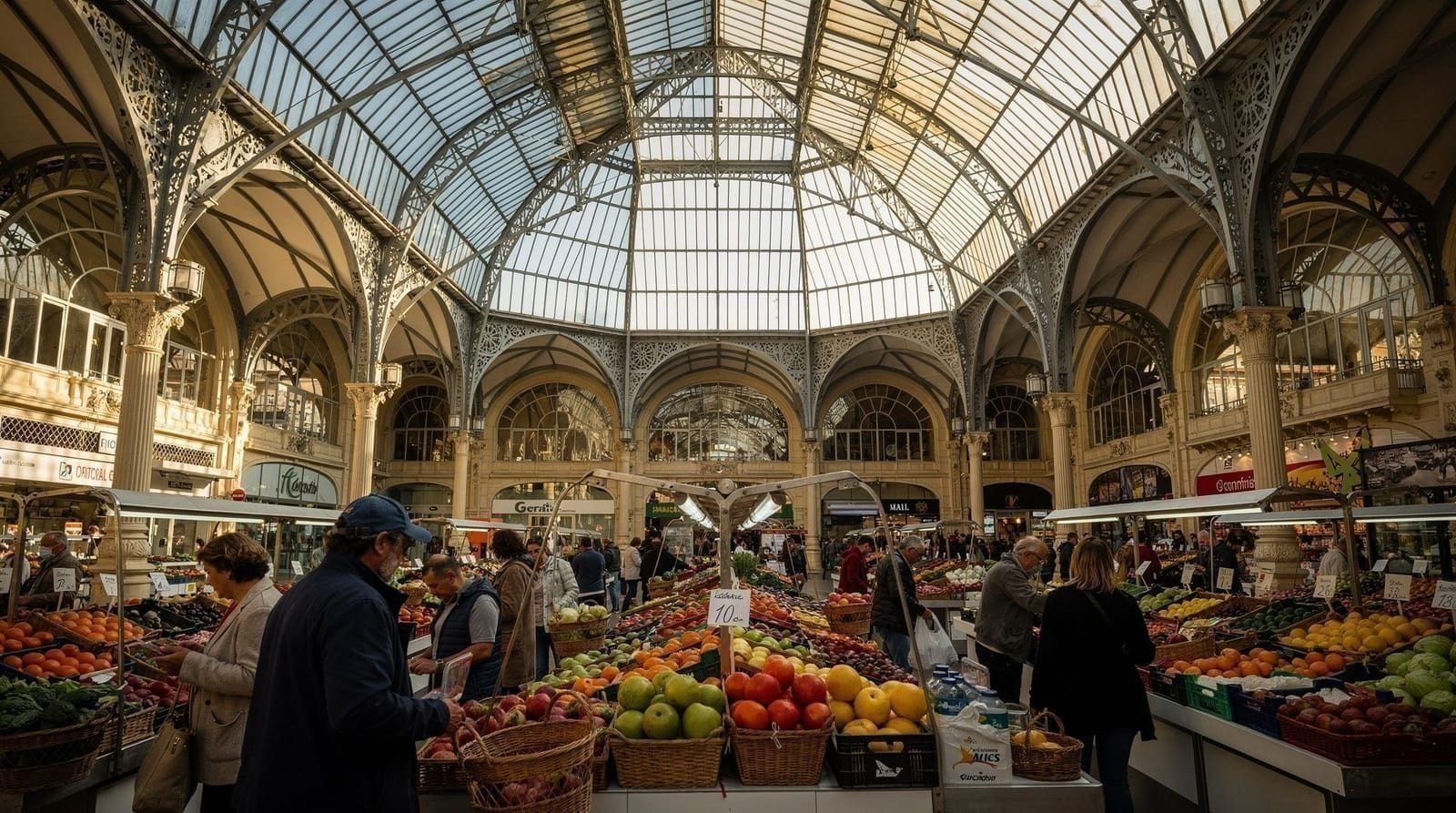
The Mercado Central (Central Market) is the largest market in Europe by floor area with a Modernista iron-and-tile structure. It covers approximately 8,000 square metres and is still operating as a daily food market with over 400 stalls selling fresh produce, fish, meat, cheese, charcuterie, and specialty foods.
The building’s exterior presents two levels: a lower brick and tile structure with Gothic-inflected arches, and an upper glazed and iron dome complex that lets in natural light across the market floor. The main dome, 30 metres in diameter, is the centrepiece — a structure of iron ribs filled with coloured glass and ceramic panels. The iron columns supporting the dome are decorated with organic Modernista foliage motifs; the ceramic panels in the lunettes above the entrances depict scenes from Valencia’s food culture.
The best approach is to enter from the Plaza del Mercado side (facing the Lonja) to encounter the main façade, then cross to the eastern market entrance for the interior. Looking up at the dome from the central axis of the market floor is the best single view.
Tourist trap alert: The tourist-oriented stalls selling pre-packaged foods and refrigerated smoothies at the market entrances are not representative of what the Mercado Central is. The actual market is in the interior stalls selling fresh goods. The smoothie stalls at the entrance charge €6–9 for fruit smoothies — avoid them; there are excellent food options inside at market prices.
For a full food tour of the market including its stalls, lunch options, and practical shopping, see the Central Market food guide.
Mercado Colón (1916)
Architect: Francisco Mora Berenguer
The Mercado Colón is the more refined of Valencia’s two major Modernista markets — smaller, more symmetrical, and better suited to photography. It was built as a neighbourhood market for the upscale Eixample district and retains the functions of a food market, though now in its conversion as a food hall and cultural space.
The building’s key feature is the pair of elaborate ceramic lunettes in the gable ends (the arched panels filling the triangular wall above the main arches at each end). These panels depict scenes of Valencia’s agricultural bounty — orange trees, artichokes, women with baskets of produce — in vivid glazed ceramics that have survived in near-original condition.
The ironwork throughout the building is of exceptional quality: delicate foliate columns, Art Nouveau decorative panels, and a semi-circular rose window in each gable that creates circular pools of light on the interior floor.
The current occupants (coffee bars, a brasserie, flower stalls, food vendors) are higher-end than the original market. The café at the far (eastern) end of the building is a good place to sit and look back at the interior.
Practical: Open daily. The flower stall at the entrance is one of the best in Valencia. On weekend mornings, an antiques and collectibles market sets up outside on Calle Cirilo Amorós.
For the full guide to eating and shopping at Mercado Colón, see the Mercado Colón guide.
Hidden Valencia tour of Eixample, Cánovas and Ruzafa — covers the neighbourhood architecture including Modernista buildings not on tourist maps
Estació del Nord (1917)
Architect: Demetrio Ribes Marco
Valencia’s main railway station is a masterpiece of applied Modernisme — and one of the best functional Modernista buildings in Spain. The station was built to replace an earlier terminus as Valencia expanded, and Ribes designed it as a statement of civic modernity appropriate to a major Mediterranean city.
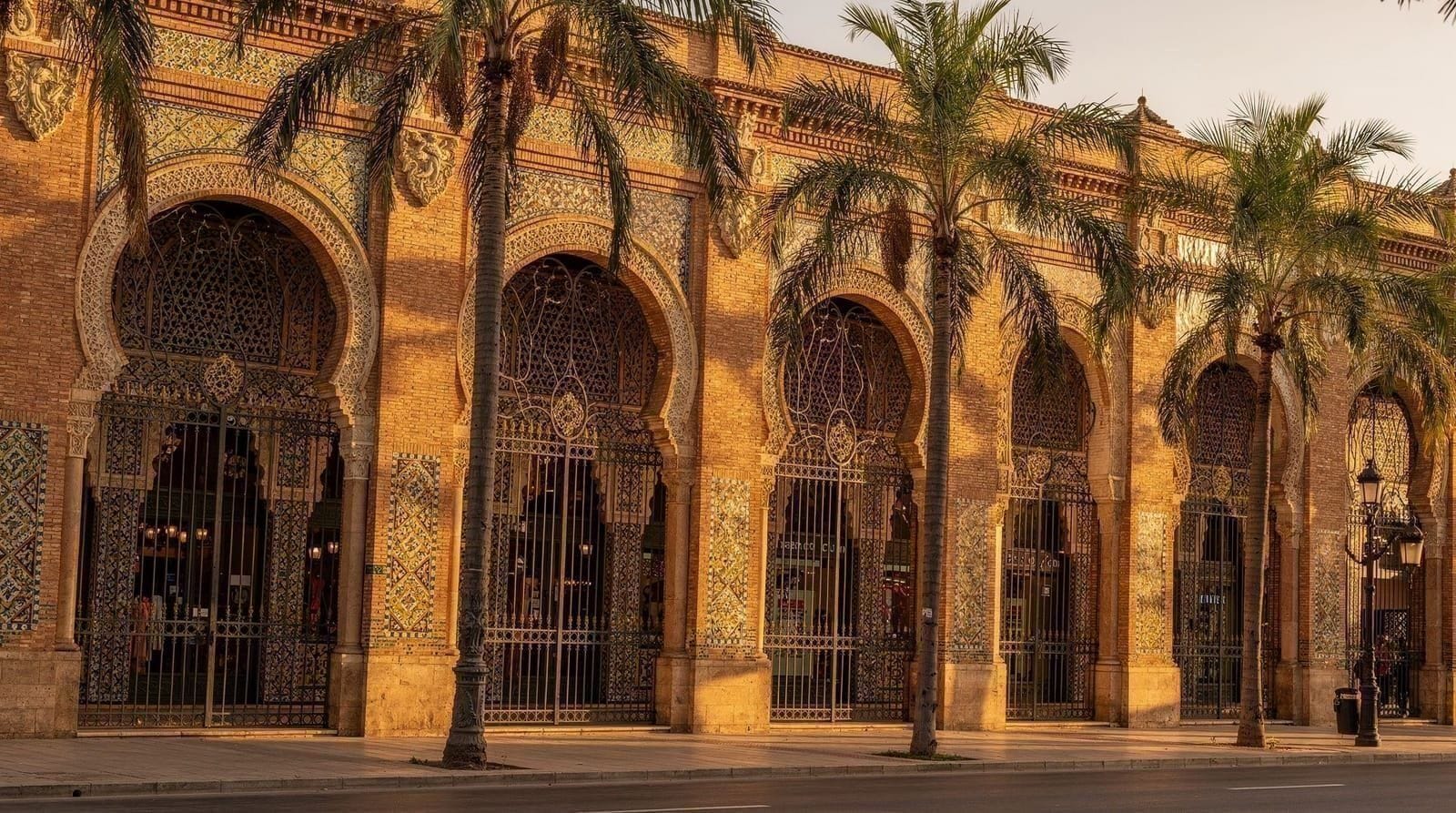
The main façade on Calle Xàtiva is marked by the Valencian orange and lemon ceramic motifs on the upper sections — vivid against the stone, clearly legible from the street, and completely specific to Valencia’s agricultural identity. The two towers flanking the main entrance are decorated with ceramic panels; the entrances themselves have elaborate ironwork grilles in organic Art Nouveau patterns.
Inside the main booking hall, the decoration intensifies. Ceramic panels cover the walls with agricultural themes — harvest scenes, market figures, and decorative borders in the rich colours of Valencian tile craft. The ceiling has elaborately painted beams; the windows use art nouveau stained glass. The iron structural work is exposed and decorative simultaneously.
The station continues operating as Valencia’s main Renfe terminal. You do not need to buy a ticket or travel anywhere to enter and look around — walk in through the main entrance, spend 20–30 minutes in the booking hall, and exit. It is free and open daily from early morning until late evening (approximately 05:00–24:00 based on train operations).
How to look at a Modernista building
Modernisme rewards slow looking, and a few habits make the three main buildings far more rewarding. Start with the top of the building and work down: the roofline, the domes and the gable ends are where the ceramic and ironwork designers allowed themselves the most freedom. Then drop your eyes to the middle band, where tile panels and stone carving tell the story of the region, and finish at street level with the door grilles, handrails and lamp brackets, which are often the best-preserved details.
Look for the same few ideas repeating in different materials. Plant forms curl through iron columns, appear again in glazed tile, and show up a third time in carved stone. Citrus fruit, leaves and flowers are everywhere because the movement drew its imagery from the surrounding countryside rather than from classical models. Once you start noticing this, you will see it on ordinary apartment buildings as well as the famous ones.
Light matters too. The market halls and the station were designed to bring daylight deep inside, so the interiors change noticeably as the morning goes on. If you are photographing, step back from the centre of the room, look for the places where light falls through glass onto the floor, and give yourself a few minutes in each building rather than a single snapshot.
Finally, remember that these are working places. Stand to one side when you stop to look up, keep your bag in front of you in the crowded parts, and treat the stallholders and commuters as the reason the buildings still exist. The pickpockets and safe areas guide has sensible advice for busy interiors.
Why Valencia built this way
The Modernista buildings make more sense when you remember what the city was at the time. Valencia was a prosperous trading and farming centre, and its growing middle class wanted public buildings that expressed confidence in the new century. Markets, stations and apartment blocks were the obvious places to show it: they were used by everyone, so the decoration was seen by everyone.
That is also why the local craft traditions mattered so much. Valencia already had a deep culture of ceramics, ironwork and carpentry, and Modernisme gave those workshops a way into architecture. The result is a style that feels rooted in place. If you have already walked the medieval and Gothic core, the contrast is striking: the Lonja de la Seda shows the city’s earlier merchant confidence in stone, while the Modernista markets show it in iron, glass and tile. The silk route guide tells the earlier part of that story if you want to connect the two periods.
Combining Modernisme with the rest of your day
The circuit works best as a half-day, which leaves room to pair it with other parts of the centre.
- With the old town. The Mercado Central sits right beside the Lonja, and the cathedral and Miguelete guide covers the monuments a short walk away. Together they make a good contrast between medieval and Modernista Valencia.
- With the Carmen quarter. After the market, the streets of the old town are close at hand. The El Carmen guide and the street art in Carmen guide suit a slower afternoon on foot.
- With a meal. The market is an obvious lunch stop, and the eat like a local guide helps you order sensibly rather than defaulting to the nearest tourist menu. For the evening, the Ruzafa tapas guide is a natural follow-on from Mercado Colón.
- With a gallery. If you want more art after the architecture, the Fine Arts Museum guide is a good indoor option when the weather turns.
If you prefer someone to explain the buildings as you go, the free walking tours guide compares the no-fee options in the old town, and the bookable walks mentioned on this page cover the same ground with a guide.
Getting between the buildings
The circuit is walkable, and walking is the best way to notice the façades along the way. If your feet need a break, the metro and EMT bus guide explains how to hop between stops, and the Valenbisi guide covers the city bike scheme for the flatter stretches. Because the centre is compact and level, none of this needs much planning.
If you are still deciding where to base yourself, the best area for first-time visitors guide shows which neighbourhoods put these buildings on your doorstep.
The Eixample: a neighbourhood of Modernista residential architecture
The Eixample (Ensanche) district — the 19th-century grid extension of Valencia built beyond the old medieval walls — was developed primarily between 1880 and 1930. It contains numerous residential apartment buildings with Modernista façades that receive minimal tourist attention because they are occupied buildings rather than public monuments.
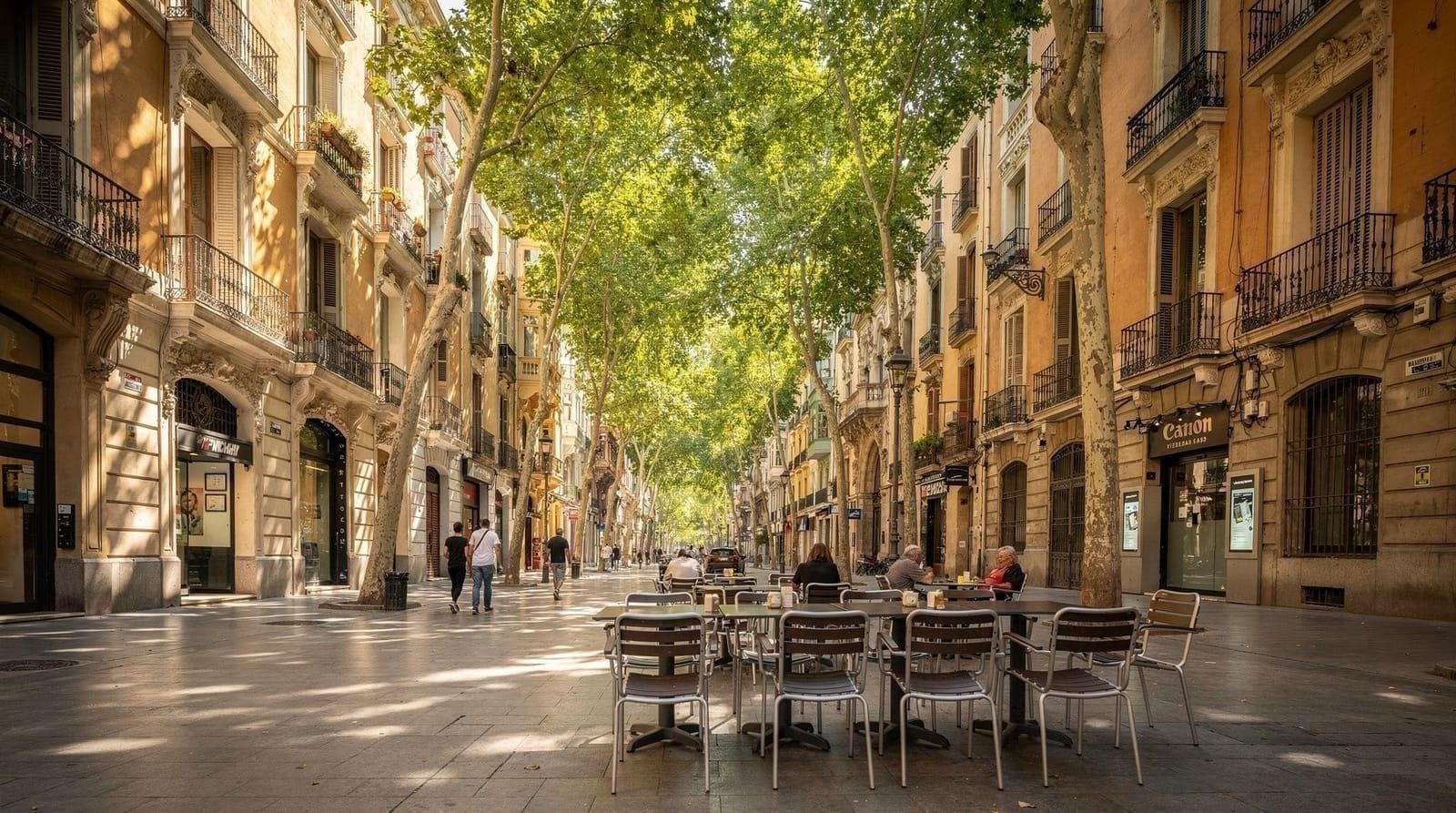
The streets around Gran Via del Marqués del Turia, Calle Cirilo Amorós, and Calle Sorní have concentrations of residential Modernisme — elaborate stone façades with ceramic inlay, wrought-iron balconies with organic designs, and polychrome tile rooflines. Walking through these streets is a good complement to the public buildings.
The Eixample neighbourhood guide covers the district in full.
Modernisme is one strand of a wider UNESCO-recognised heritage story in Valencia — the UNESCO Valencia guide covers how it sits alongside the city’s Gothic monuments and intangible cultural heritage such as Las Fallas.
A Modernisme walking circuit
The three main buildings can be visited in a single 2–3 hour circuit:
Start: Estació del Nord (Calle Xàtiva) — 20–30 minutes inside the booking hall
Walk north along Calle Xàtiva to Plaza del Ayuntamiento — 10 minutes
Continue north via Calle San Vicente Mártir to Plaza del Mercado — 5 minutes
Mercado Central — 45–60 minutes (or longer if buying food)
Walk east along Calle de la Abadía de San Martín and Calle de la Paz — 15 minutes
Mercado Colón (Calle Cirilo Amorós) — 20–30 minutes
Optional add-on: From Mercado Colón, 10 minutes south brings you to Ruzafa (Ruzafa guide), which has its own street culture and restaurants.
Historical city tour of Valencia — includes the key civic monuments and architectural highlights in a guided 2-hour walk
Fitting the circuit into a longer stay
Modernisme is rarely a reason to visit Valencia on its own, but it fits neatly into almost any itinerary. On a short trip it slots in as a morning activity before the heat of the day builds. The Valencia in one day itinerary and the three-day itinerary both pass close to these buildings, so you can fold the stops into a route you are already planning. If you are still working out how long to stay, the how many days in Valencia guide helps you decide.
Travellers who enjoy this kind of urban detail often go on to explore the city’s other neighbourhoods on foot. The Ruzafa district guide is a good next step, and the Turia gardens guide offers a green, open counterpoint after a morning among iron and tile.
Frequently asked questions about Modernisme in Valencia
Is Valencia's Modernisme as good as Barcelona's?
Different in character and scale. Barcelona's Modernisme (Gaudí, Domènech i Montaner, Puig i Cadafalch) is larger in scope and more internationally recognised. Valencia's Modernista buildings are less monumental but often more integrated into daily city life — the Mercado Central is a working market, the Estació del Nord is Valencia's main train station, the Mercado Colón is a functioning food hall. They are buildings that function rather than icons preserved for tourism.Can I go inside the Mercado Central for free?
Yes — the Mercado Central is a public market open to everyone. Entry is free. You are expected to buy something if you are inside (the stall holders are selling food, not operating a museum), but browsing is tolerated. The best time to visit for architecture is on weekday mornings when it is busy but not overwhelmingly crowded. It closes at 15:00 Monday–Saturday; closed Sundays.What is Mercado Colón and what is it used for now?
Mercado Colón was built in 1916 as a neighbourhood market and converted in 2003 into a food and culture hall. The original Modernista structure — iron and ceramic, with elaborate tiled lunettes in the gable ends — was preserved and restored. Today it houses upscale food stalls, coffee bars, a brasserie, florists, and a weekend antique market. The architecture is best appreciated from inside or from the café area at the far end.What is special about Estació del Nord's architecture?
The station (1917, Demetrio Ribes) is a tour de force of Valencian Modernisme applied to a functional railway terminal. The main façade uses orange and lemon ceramic motifs (a reference to Valencia's agricultural identity) in Art Nouveau tiles. The interior has elaborate woodwork, ceramic panels showing agricultural themes, and a glass-and-iron roof structure. The booking hall is one of the most photographed interiors in Valencia.Are there other notable Modernista buildings in Valencia?
Yes — Casa del Punt de Ganxo (Calle de las Avellanas, 1914), the Farmacia Vendrell (corner of Gran Vía Marqués del Turia and Calle Salamanca), the façade of the Ateneo Mercantil (Plaza del Ayuntamiento area), and several residential buildings in Eixample. The Eixample district as a whole was planned and built in the late 19th and early 20th century, and contains numerous residential Modernista facades that get no tourist attention.Can I visit the interior of Estació del Nord without taking a train?
Yes — it is a functioning public railway station. Entry is unrestricted. The booking hall is the most architecturally interesting space.Is there a guided Modernisme tour of Valencia?
The hidden Eixample tour comes closest to a dedicated Modernisme walk. General historical walking tours include the Mercado Central and cover the Modernista context. A self-guided walk following the circuit above is perfectly achievable.How does Valencian Modernisme relate to Art Nouveau elsewhere?
Valencian Modernisme is a regional expression of the same movement that produced the Paris Metro entrances (Hector Guimard), the Palais Stoclet in Brussels (Josef Hoffmann), and the Secession Building in Vienna. The Valencian version has a particular emphasis on ceramics as decorative medium and a colour palette rooted in the region's agricultural products (oranges, lemons) rather than the blues and greens more common in northern European Art Nouveau.What happened to Modernisme as an architectural style?
The style declined sharply after World War I, replaced by Rationalism and later Brutalism. In Valencia, the transition is visible in buildings of the 1930s–1950s — spare, functional, and deliberately stripped of ornament. The Modernista buildings that survive are from the last flowering of the tradition before rationalism took hold.
Top experiences
Bookable activities with verified prices and instant confirmation on GetYourGuide.