How to order paella in Valencia like a local
Valencia: master the art of paella in an authentic Valencian kitchen
Duration: 2 hours
How do you order paella properly in Valencia?
Go to a rice-specialist restaurant at lunch (never dinner). Order for minimum two people. Ask "¿está hecha al fuego de leña?" (is it cooked over wood fire?) to filter out tourist versions. Expect 20-30 minutes wait. Budget 15-25€ per person.
Ordering paella in Valencia correctly requires knowing a few things that most tourist-facing restaurants actively do not want you to know. This guide walks through the process step by step — from choosing the restaurant to asking the right questions to handling the bill.
| When | Lunch only, 14:00-16:30 (never dinner) |
| Cost | Around 15-25€ per person at a rice specialist |
| Wait | 20-30 minutes cooking time — non-negotiable |
| Minimum | Two people per pan |
| Key question | ”¿Está hecha al fuego de leña?” (wood fire?) |
Step one: choose the right type of restaurant
Not every restaurant that offers paella on its menu is a rice-specialist restaurant. There is a meaningful difference. A rice specialist (arrocería or restaurant specialising in arroces) takes rice cooking seriously, has a wood fire or specialised equipment, and typically offers 8-15 different rice dishes. They are judged locally on their rice.
A general restaurant that happens to have paella on the menu may be offering a convenience item — cooked in advance, kept warm, and served when ordered. This type of paella can look identical to the real thing from a distance.
How to identify a rice specialist:
- The menu lists multiple rice dishes (arroz valenciana, arroz a banda, arroz negro, fideuà, arroz al forn)
- The menu specifies minimum two people for paella
- The menu states that paella requires 20-25 minutes cooking time
- There is no paella on the dinner menu (or the restaurant closes at 16:00)
- It is near Malvarrosa beach, El Palmar, or is one of the city establishments with a history (Casa Carmela, Restaurante Navarro)
For specific restaurant recommendations, see where to eat authentic paella in Valencia.
Step two: call ahead or book online
For weekend lunch at any reputable paella restaurant, booking is not optional — it is necessary. La Pepica, Casa Carmela, and the El Palmar restaurants fill up by 14:30 on Saturdays and Sundays. A call the day before, or an online booking, takes 2 minutes and saves an unnecessary disappointment.
For weekday lunch, it is usually possible to walk in, but calling ahead guarantees a table and signals to the restaurant that you are planning a serious meal.
When booking, mention that you want paella valenciana specifically. Some restaurants pre-prepare their paellas based on bookings, particularly for larger parties. This is not a sign of low quality — it is good logistics.
Step three: arrive at the right time
Paella is a lunch dish. Lunch service in Valencia runs from approximately 14:00 to 16:30. Arriving at 14:00 is ideal — the kitchen is at full capacity, and your 20-30 minute wait puts you eating around 14:30, which is when a Valencian family would also be eating.
Arriving at 13:00 or 13:30 is possible at tourist-facing restaurants but will often result in being the only table eating while the kitchen is still warming up. The paella you get at 13:30 may not have the same care as one prepared at peak service.
Paella is never an evening meal. If a restaurant offers paella at dinner, that is a tourism product, not an authentic dish.
Step four: ask the key question
When the waiter arrives, before looking at the menu in detail, ask: “¿Está hecha al fuego de leña?” (Is it cooked over a wood fire?).
At a serious paella restaurant, the answer will be immediate and confident: yes, we use orange wood / pine wood / vine wood. The waiter may even take you to see the fire or describe the process.
If the answer is vague (“we have a special oven”), evasive, or if the waiter does not understand the question, you are in the wrong restaurant for authentic paella.
A follow-up question: “¿Cuánto tarda?” (How long does it take?). The honest answer is 20-25 minutes. If the waiter says 5-10 minutes, the paella was pre-cooked.
Step five: what to order and what to skip
Order
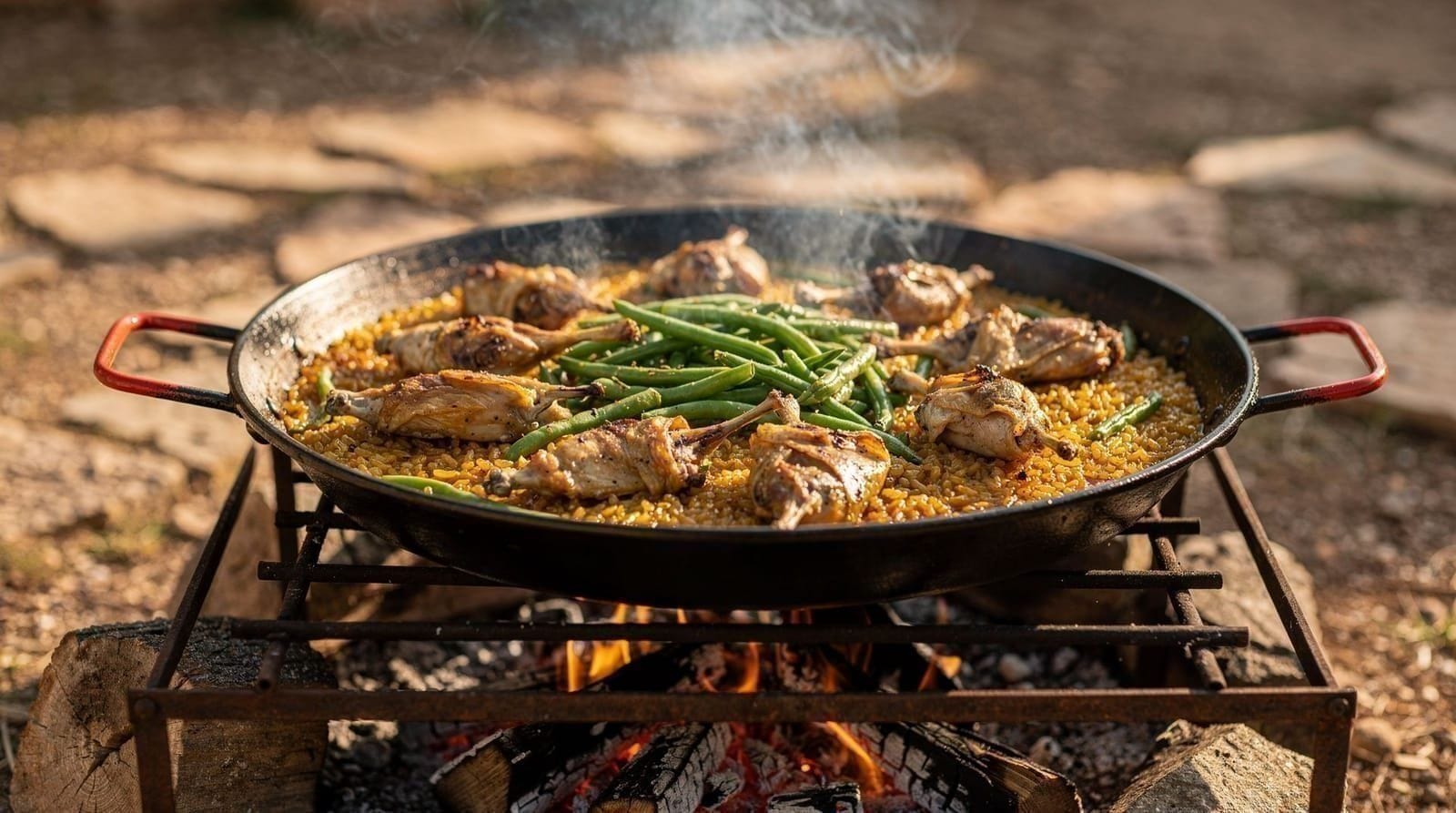
- Paella valenciana (chicken, rabbit, vegetables) — the traditional dish
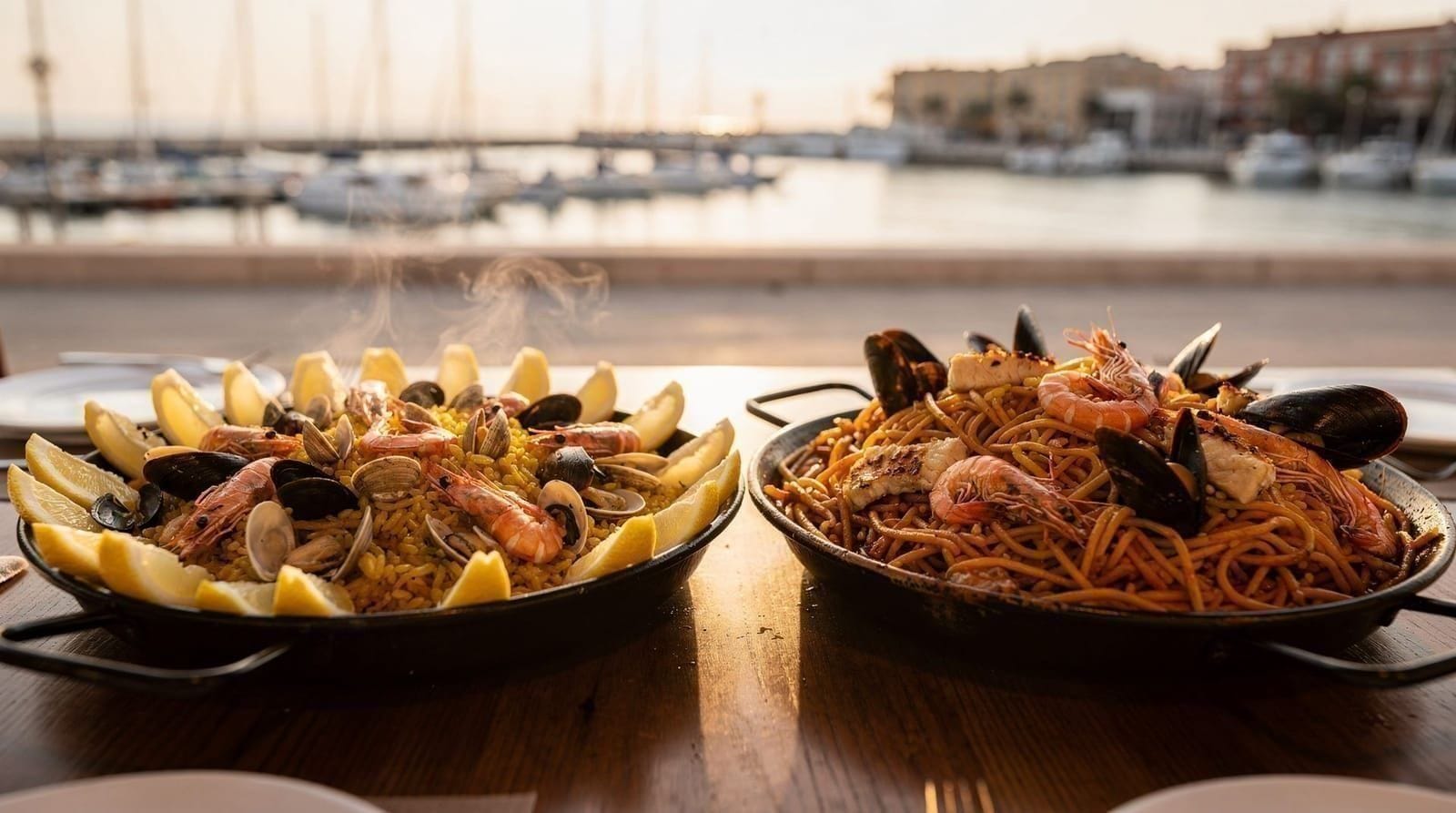
- Arroz a banda if you prefer seafood rice (available in individual portions)
- A cold carafe of house wine (ask for “vino de Requena” or “vino de la tierra”)
- A simple salad to start, if you want something beforehand
Do not order
- Bread — if it arrives uninvited, you can decline it or accept knowing it will cost 3-5€ per person. Many tourist restaurants bring bread automatically as a revenue mechanism. A simple “no, gracias” when it arrives is completely acceptable.
- Starters that will fill you up — paella is substantial
- Agua de Valencia with lunch (see Agua de Valencia guide) — it is a cocktail with a cocktail’s alcohol content and does not pair well with a serious rice meal
- Individual portions for a table of more than one — order one paella for the table and share it from the pan
Order for two minimum
Traditional paella is cooked in a pan sized for two or more. The smallest authentic paella pan serves two. Do not expect to order a single portion — most serious restaurants will refuse. If you are eating alone, order a different rice dish.
Step six: wait (genuinely)
When the waiter returns to take your order and you ask for paella, they will note the time, confirm the minimum number of people, and tell you it will be 20-25 minutes. This is accurate. The pan goes on the wood fire, the base is prepared, the chicken and rabbit are browned, the stock is added, the rice goes in, and the socarrat forms.
Use this time to have your drink, your olives, and your salad. Do not rush the kitchen. Do not ask for the paella early. The 20-25 minute wait is not a delay — it is the cooking time.
Step seven: when it arrives
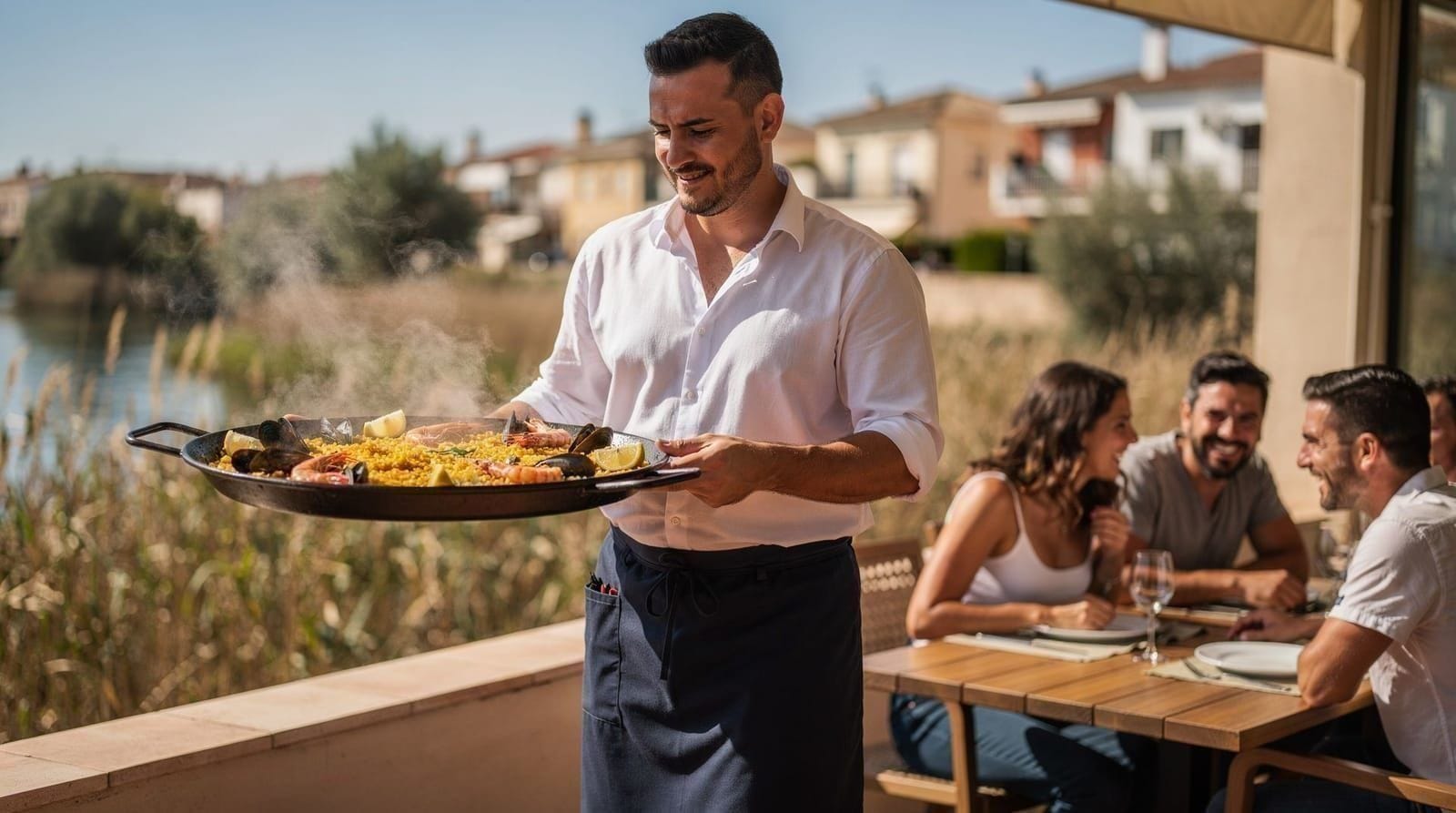
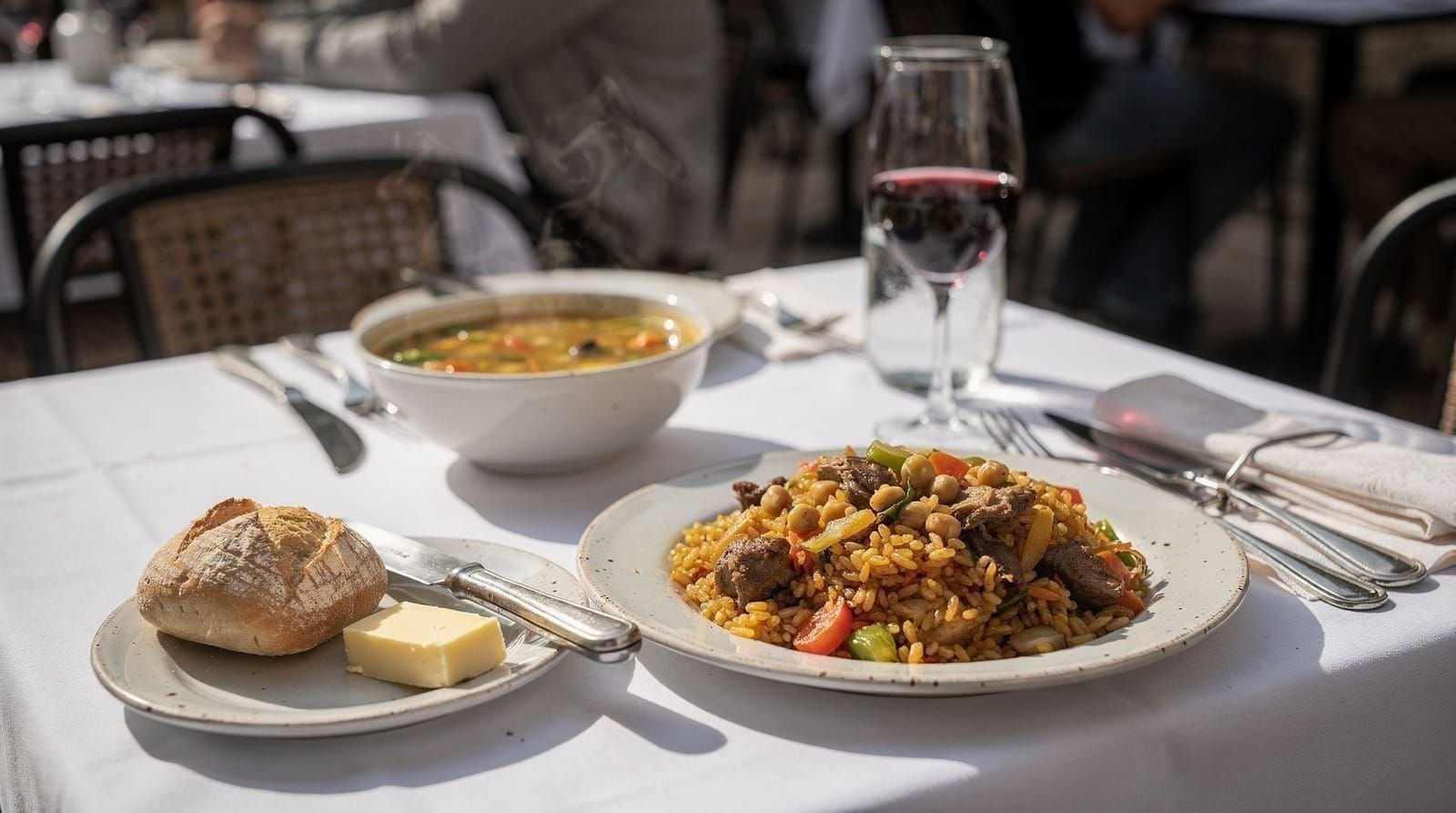
The pan will arrive at the table still in the cooking vessel. It should not be transferred to plates by the waiter — you serve yourself from the pan. The rice should be:
- Dry and separate, not sticky or creamy
- Yellow-orange, coloured from saffron (not food colouring, which looks more vivid)
- Hot, with the pan still warm to the touch
- Socarrat at the bottom — use your spoon to scrape gently and check
A lemon wedge will be provided. Squeeze it over your portion. Eat from the pan, not a separate plate.
If the paella arrives in pre-portioned plates rather than the pan, or if the rice is mushy, sticky, or uniformly beige, it was not cooked properly. This is useful information for future reference.
Step eight: handle the bill correctly
Ask for the bill with “la cuenta, por favor”.
Check the bill for:
- Cubierto or cubiertos: a per-person cover charge (0.50-2€ per person, common and legitimate)
- Pan: bread charge if you accepted bread or did not refuse it
- Agua: mineral water charge (restaurants often bring it automatically — you pay for it)
Any charge you did not order or consume is disputable. In practice, small overcharges are less common at serious rice restaurants than at tourist-facing ones near the cathedral.
Taking a cooking class
Valencia: master the art of paella in an authentic Valencian kitchenIf you want to understand the process from the inside, a cooking class is the most effective option. You see the wood fire, the technique, the socarrat forming, and you eat the result.
Valencia: paella cooking class with Central Market tourThe best classes include a morning visit to the Mercado Central to buy ingredients, followed by the cooking session. This gives context for what makes the ingredients matter.
Where prices differ across the city
Paella pricing varies noticeably by location, and understanding the pattern helps set expectations before you sit down.
| Area | Typical price/person | Notes |
|---|---|---|
| Near the Cathedral / old town tourist strip | 18-28€ | Highest risk of pre-cooked or reheated versions |
| Russafa | 15-22€ | Mixed — some genuine rice specialists among general restaurants |
| Malvarrosa beachfront (set back from boardwalk) | 15-20€ | Long-established rice houses, generally reliable |
| El Palmar / Albufera | 16-24€ | Closest to the dish’s origin, often includes boat trip packages |
As a rule, price alone doesn’t guarantee authenticity — a wood-fired paella at 16€ in a family-run Russafa restaurant can beat an overpriced 25€ version metres from the Cathedral. Use the questions above rather than price as your main filter.
A note on tourist paella and the honest choice
There is nothing wrong with eating a convenience version of paella at a tourist restaurant if you know that is what you are doing and the price reflects it. The problem is when tourists pay 18€ for a reheated product and think they have experienced authentic Valencian paella.
If you are in Valencia for one day and want to eat paella, it is worth the extra planning to get to Malvarrosa or El Palmar, book in advance, and eat the real thing. If you are short on time, a cooking class may be more satisfying than a mediocre restaurant experience.
For everything that can go wrong, see the tourist traps Valencia guide and the paella traps guide.
Paella vs other Valencian rice dishes
Paella valenciana isn’t the only rice dish worth ordering, and knowing the alternatives helps if you’re travelling solo or want variety across a longer stay. Arroz a banda (rice cooked in fish stock, seafood served separately) is available in individual portions, making it the practical choice for solo diners. Arroz negro (squid-ink rice) is seafood-based and dramatic to look at. Fideuà replaces rice with short noodles and is a Gandia-area specialty rather than a Valencia city dish — see the paella vs fideuà guide for the full comparison. All i pebre (eel stew with potatoes) is an Albufera specialty worth trying in El Palmar alongside paella if you’re making the trip anyway — see the all i pebre guide.
Combining paella with a day trip
Some of the best paella in the region is served away from the city centre, which makes it worth planning around a half-day excursion rather than a standalone meal. El Palmar, inside the Albufera Natural Park, has a cluster of rice restaurants that supply much of the fresh produce and duck used in traditional recipes — combining lunch there with an Albufera boat trip makes for a full, satisfying afternoon. If you’re staying near Malvarrosa beach, several long-established rice restaurants along the seafront (Casa Carmela, La Pepica) let you follow lunch with a walk on the sand — just avoid the row of restaurants directly on the boardwalk, which tend to charge tourist prices for a lower standard.
Valencia: authentic paella cooking classFrequently asked questions about How to order paella in Valencia like a local
What time should I arrive to eat paella?
Arrive between 14:00 and 15:00 for the best experience. Spanish lunch service runs 14:00-16:00. Arriving at 13:30 is fine in tourist-facing restaurants, but authentic establishments often start their lunch rush closer to 14:00. Paella requires 20-30 minutes cooking time, so factor in the wait after ordering.What questions should I ask before ordering?
Ask "¿Está hecha al fuego de leña?" (cooked over wood fire?). Ask how long it takes to prepare. Ask if the socarrat is included. At tourist restaurants, you may get evasive or confused answers. At good restaurants, the waiter will answer confidently — the wood fire is a point of pride.Can one person order paella?
Traditional paella is cooked in a pan sized for two people minimum. Most quality restaurants will not cook a paella for one. If you are eating solo, consider ordering arroz a banda (rice in fish stock) or arroz al horno, which are available as individual portions. Or find another solo traveller to share with.What should I not order along with paella?
Do not order starters that will fill you up — paella is substantial. Avoid ordering bread (it will be charged automatically at 3-5€ per person). A green salad, some olives, or a cold drink before the paella is appropriate. Do not order paella and also fideuà — pick one.How do I tell if the paella is fresh or reheated?
Fresh paella arrives in the pan it was cooked in, still sizzling slightly. The rice is dry and separate, not clumped or mushy. The bottom has socarrat — a slightly caramelised, toasted layer. Reheated paella looks flat and uniform, the rice is often slightly sticky or dry in a different way. The colour from saffron is more muted.What wine should I order with paella?
A young Bobal or Garnacha from Requena (the local wine DO, 65 km west of Valencia) is the natural local pairing. Ask for "vino de Requena" or "vino de la tierra" and you will usually get something appropriate for 6-10€ a carafe. A cold local beer also works. Avoid Agua de Valencia with a serious paella lunch — it is a cocktail, not a food wine.Is it rude to ask about the cooking method?
No. In a good restaurant, asking about the cooking method signals that you care about the food and is received positively. It is not rude to ask "¿es auténtica valenciana?" either. The rude thing would be to complain after accepting tourist paella at a tourist price.What should I do if bread arrives without ordering it?
You can ask them to remove it — "no hemos pedido pan" (we did not order bread). If it has already been touched, you will likely be charged regardless. This is a common practice at tourist-facing restaurants near the cathedral. At serious rice restaurants, it does not typically happen. See the guide on tourist traps.What if I have dietary restrictions?
Traditional paella valenciana contains meat (chicken, rabbit). It cannot meaningfully be made without it. If you cannot eat meat, ask about arroz con verduras (vegetable rice) or arroz negro (squid ink rice, which is seafood-based). Most rice-specialist restaurants have options.Is 15€ per person really the minimum for good paella?
At serious restaurants in 2026, yes. The cost of the ingredients — saffron, rabbit, free-range chicken, fresh vegetables — combined with the wood and the labour does not permit quality paella below that price point. Budget 20€ per person and you will have comfortable headroom for a good experience.What if I do not speak Spanish?
Most reputable Valencia paella restaurants have English menus or English-speaking staff. However, asking the key questions ("fuego de leña?", "cuánto tarda?") in Spanish signals engagement with the food and tends to get better service. A translation app is fine.
Top experiences
Bookable activities with verified prices and instant confirmation on GetYourGuide.