Torres de Serranos and Torres de Quart: Valencia's medieval gates
Valencia: historical city tour
Are the Torres de Serranos worth visiting in Valencia?
Yes. The two surviving medieval gates of Valencia's 14th-century walls offer the best rooftop views of the old city beyond the Miguelete. Entry is €2 each (free on Sundays). The Torres de Serranos is the larger and more impressive; both can be visited in under two hours.
Valencia’s 14th-century city walls were demolished in 1865 to allow the city to expand, but two of the original 12 gates survived: the Torres de Serranos in the north and the Torres de Quart in the west. Both are in excellent condition, both offer rooftop views across the old city, and both charge €2 entry (free on Sundays). Together they can be visited in a single relaxed morning that also takes in the adjacent El Carmen neighbourhood.
| Where | Northern (Serranos) and western (Quart) edges of El Carmen |
| Cost | €2 each, €4 combined; free on Sundays |
| Time needed | 30 min each, or a half-day loop combining both |
| Getting there | Both are a 15–20 min walk apart through El Carmen |
| Best time | Weekday mornings; Sundays for free entry but slightly busier |
Torres de Serranos
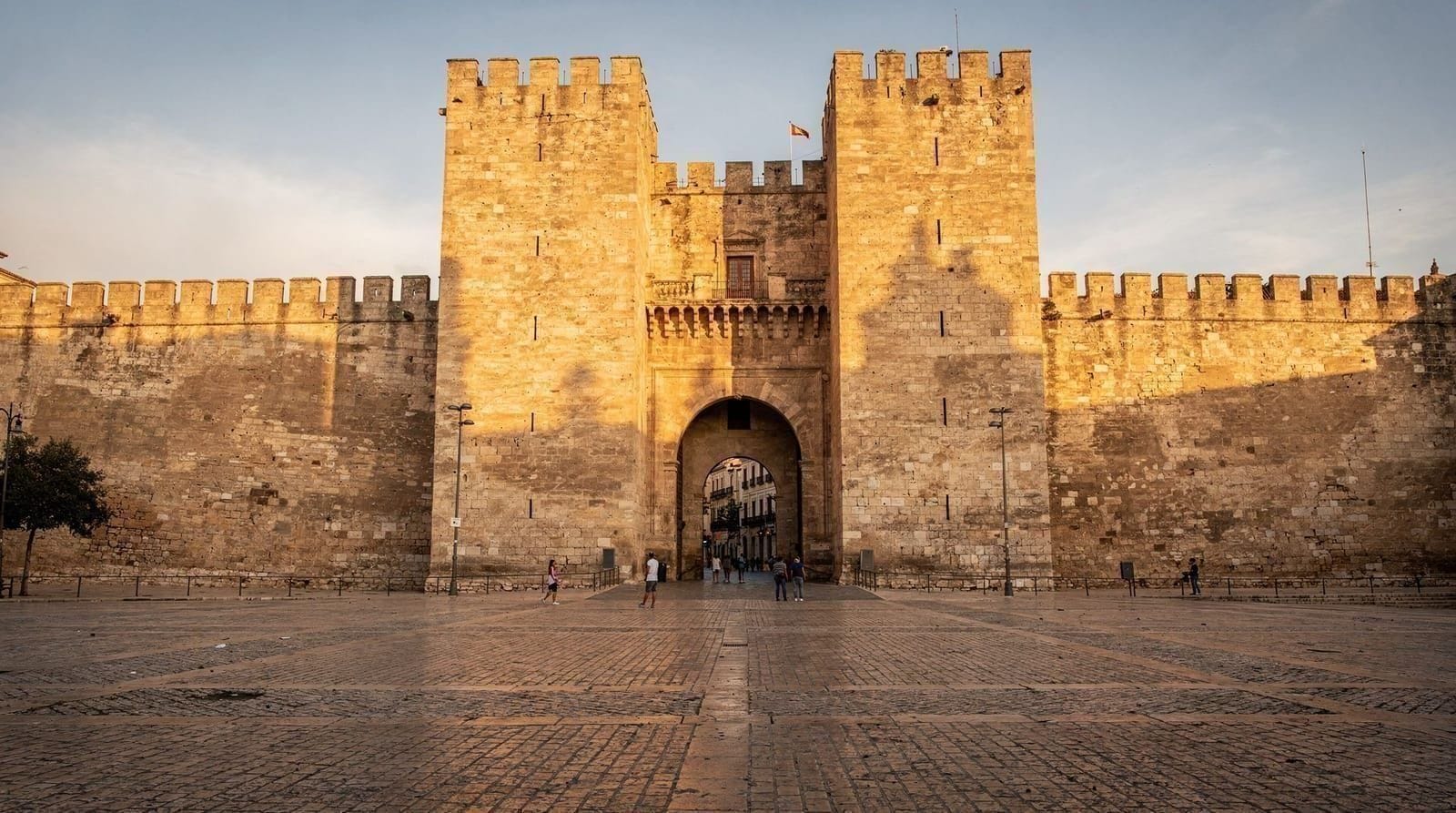
The Torres de Serranos, built between 1392 and 1398 by Pere Balaguer, is the northern gate of the old city walls. Two octagonal towers of light-coloured limestone rise 26 metres above the original gate arch, connected by a battlemented wall. The gate faces north across a small square (Plaza de los Fueros) and the old Turia riverbed — now the northern section of Turia Gardens.
Inside the towers: The gate is hollow — the interior is a single large ceremonial space that served as the public entrance to the medieval city for important visitors, ambassadors, and royal processions. The rooms are bare of furnishings and decoration but structurally impressive: Gothic vaulting, deep-set windows, and stone floors polished smooth by centuries of use.
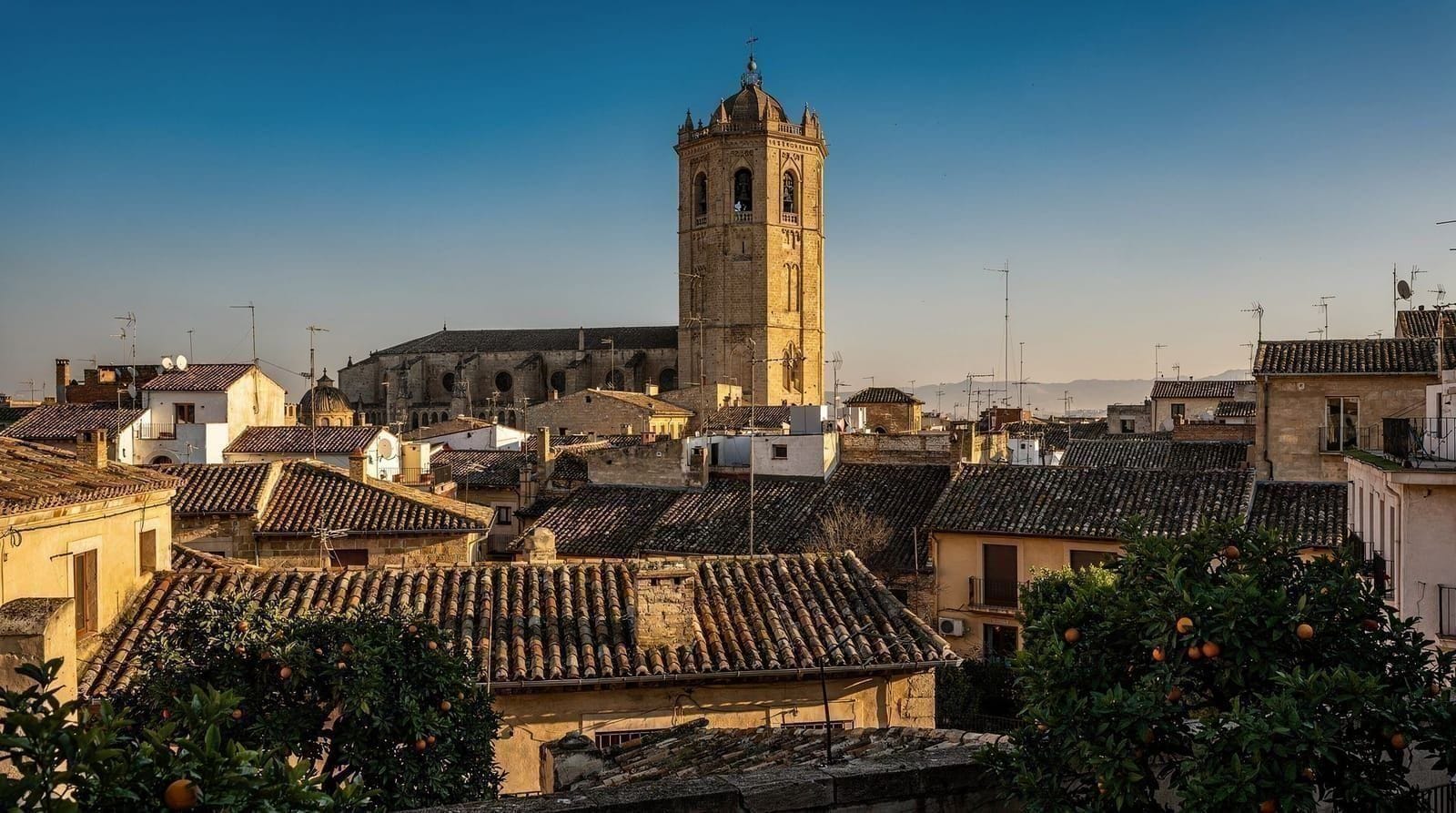
The roof: The towers are accessible by staircase to the battlemented rooftop walk. The view from here takes in the Turia Gardens to the north (where the riverbed is now a park), the Cathedral Miguelete tower to the southeast, the Fine Arts Museum across the river to the northeast, and the roofscape of the old city in every direction. It is not as high as the Miguelete but it is wider and less crowded.
Historical use: The Torres de Serranos served as the royal prison from the 18th century until 1887. Prisoners were held in the lower rooms of the gate; the prison’s existence is documented by carved graffiti on the interior stone walls, some dating from the 18th century and legible today.
The Tribunal de las Aguas connection: Every Thursday at noon, the Tribunal de las Aguas — the world’s oldest functioning court, which adjudicates irrigation water disputes in the Valencia huerta — meets at the Apostles door of the Cathedral. Its origin traces to the Moorish water management systems that predated the current city walls. The Torres de Serranos was the gate through which the Moorish population of the city historically passed; the juxtaposition of these two medieval survival institutions — the gate and the court — is one of the stranger continuities in Valencia’s urban history.
Torres de Quart
The Torres de Quart (also called Torres de Cuarte in Castilian) are the western gate, built between 1441 and 1460. They are round rather than octagonal, heavier in proportion than the Serranos, and show a different architectural temperament — more fortress, less ceremonial. The towers were inspired by the Castel Nuovo in Naples, reflecting Valencia’s political connections with the Aragonese Kingdom of Naples in the 15th century.
Visible bombardment damage: The exterior walls of the Torres de Quart carry clearly visible damage from artillery impacts — not from the medieval period but from the 1808 Napoleonic siege and from the Spanish Civil War (1936–39). The holes from cannonballs and shells are deliberately left unrepaired as historical testimony. This is one of the most visible examples of 20th-century conflict archaeology in Valencia.
Views: The rooftop walk at Torres de Quart looks west toward the Barrio del Carmen and the IVAM building, and south toward the modern city. Less dramatic than the Serranos view but worthwhile in its own right.
Lower-level access: The interior rooms of the Quart towers are more developed than the Serranos — there are small interpretation panels covering the history of the walls and the gate’s various historical uses, including its role during the Napoleonic occupation.
Practical information
Torres de Serranos opening hours (2026):
- Monday–Saturday: 10:00–19:00
- Sunday and public holidays: 10:00–14:00
- Closed 1 and 6 January, 1 May and 25 December
Torres de Quart opening hours (2026):
- Monday–Saturday: 10:00–19:00
- Sunday and public holidays: 10:00–14:00
- Closed 1 and 6 January, 1 May and 25 December
Ticket prices (both):
- Adults: €2 each
- Reduced: €1 each
- Under 12: free
- Sundays: free for all
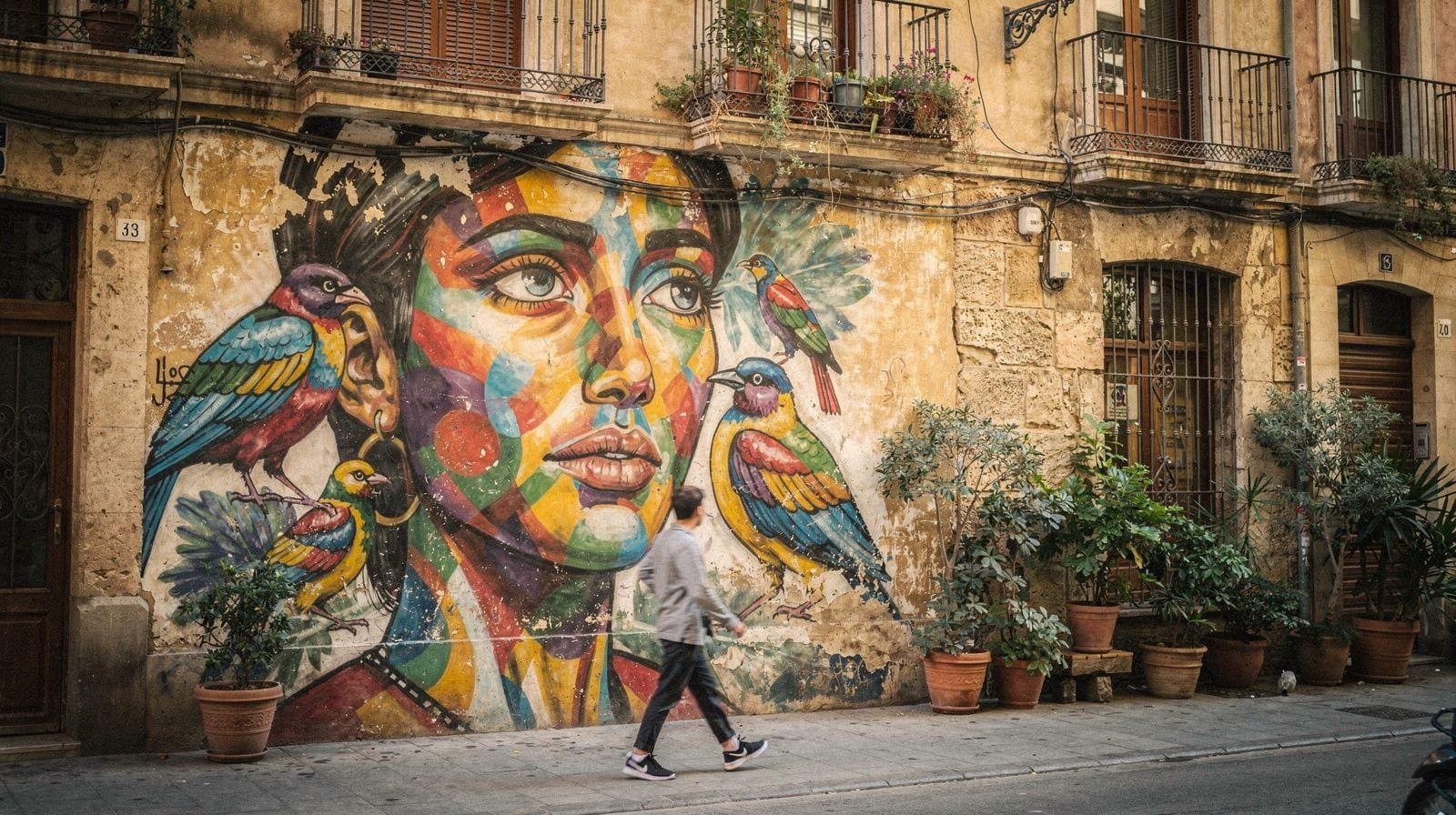
Combined visit: Both towers can be visited for €4 per adult. The walk between them along the southern edge of El Carmen takes 15–20 minutes — you pass through streets with some of the best street art in the neighbourhood.
Serranos vs Quart at a glance
| Torres de Serranos | Torres de Quart | |
|---|---|---|
| Built | 1392–1398 | 1441–1460 |
| Shape | Octagonal, ceremonial | Round, fortress-like |
| Standout feature | Larger, more dramatic rooftop view | Visible cannonball and artillery damage |
| Historical use | Royal prison (18th c.–1887) | Defensive gate, Napoleonic siege target |
| Best for | First-time visitors, best single stop | History enthusiasts, military/conflict history |
How to visit both in a morning
A practical half-day walks you through the best of medieval Valencia:
- Torres de Serranos (30 minutes): arrive at 10:00, climb to the roof, look east toward the Cathedral and south over the old city.
- Walk south through El Carmen (20 minutes on foot): Calle de la Beneficència and Calle dels Cavallers pass through the heart of the medieval neighbourhood, with Roman and Islamic remains visible in the street plan.
- Torres de Quart (30 minutes): arrive at the western gate, inspect the shell damage, climb to the roof.
- Coffee in El Carmen (15 minutes): café tables in Plaza del Tossal, 200 m east of the Quart towers.
From Torres de Quart, the IVAM is a 5-minute walk north. The Central Market and Lonja de la Seda are 15 minutes south and southeast.
 medieval guided walking tourCheck availability
The medieval walls: what was lost
The demolition of the city walls in 1865 was a decision made by the Valencia city council to enable urban expansion — the same logic that eliminated the walls of hundreds of European cities in the 19th century. The 12 original gates were torn down, the walls themselves levelled, and the stone reused in construction elsewhere. The two surviving towers were spared by a city council vote that came down to a margin of one.
The moat that surrounded the walls was partially converted into a boulevard (today’s Gran Vía de Ramón y Cajal) and partially built over. The line of the old walls is still traceable in the street pattern — the diagonal line from the Torres de Serranos to the Torres de Quart corresponds roughly to the circuit of the medieval wall.
For historical walking tours that cover the medieval city in depth, including the wall circuit and the towers:
 historical city tourCheck availability
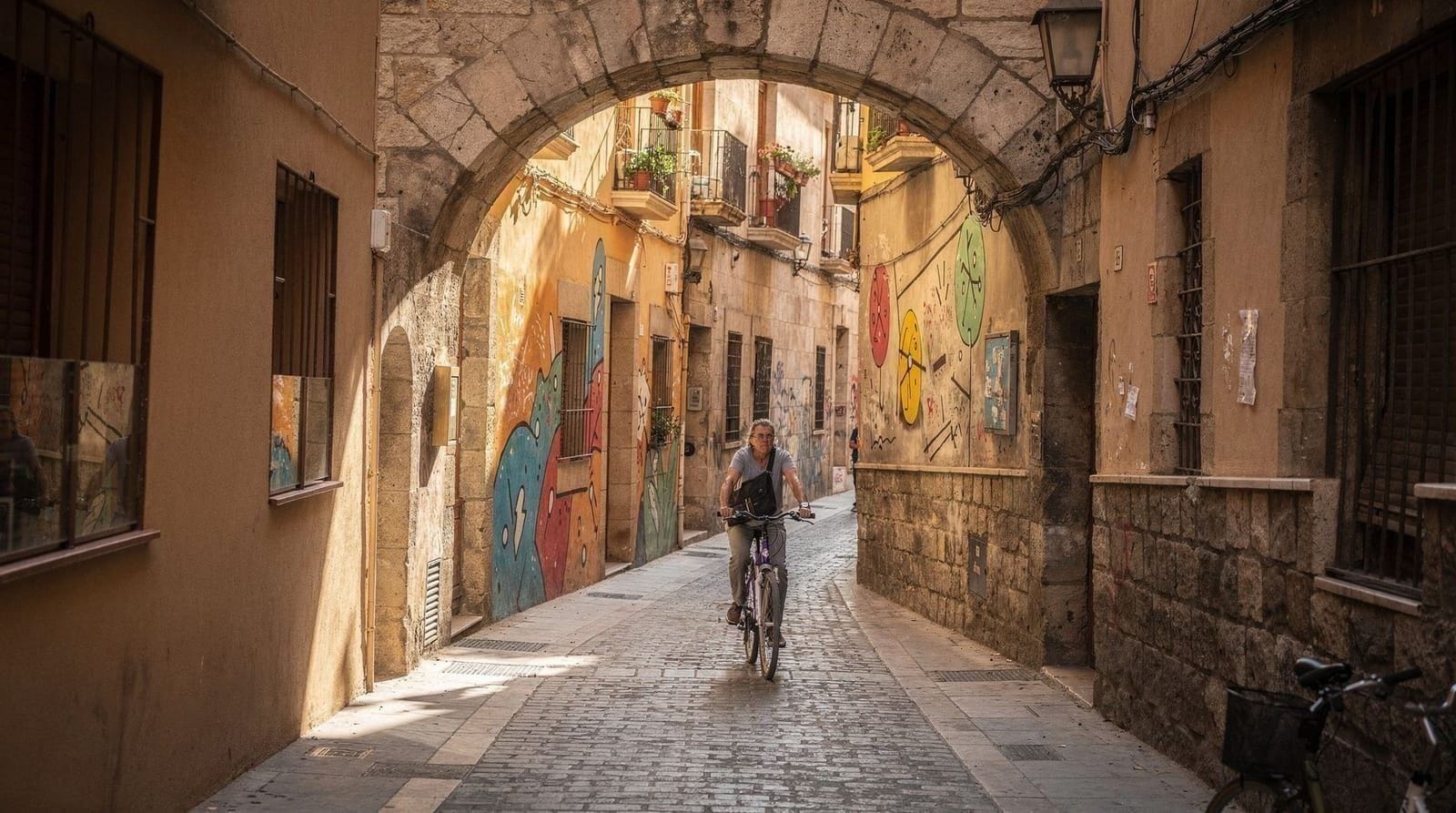
The El Carmen guide covers the neighbourhood between the two surviving towers in detail, including the best street art and the archaeological sites with Roman and Moorish remains visible through pavement glazing.
What to look for once you are inside
Both gates reward a slow pace. At the Serranos, take a moment on the ground floor before heading for the stairs: the bare ceremonial space makes more sense once you picture a procession arriving under the arch, and the carved graffiti on the walls is easy to miss if you go straight up. On the roof, pick one direction at a time. Start with the Turia side, where the old riverbed becomes a green ribbon, then turn toward the Cathedral and match the skyline to what you read in the Cathedral and Miguelete guide. If you plan to climb the Miguelete later in the trip, the Serranos roof is a good rehearsal for the layout of the old city.
At the Quart, the exterior is half the visit. Walk along the outside of the towers before paying, and look at the pockmarked stone from a few steps back; the damage reads better at a distance than up close. Then go in and use the interpretation panels to place the gate within the larger story of the walls. The round towers feel heavier and more defensive than the Serranos, and standing on the roof you can see why the gate was a target.
Fitting the towers into a longer stay
The two gates sit comfortably inside a wider old-town plan. If you only have a short trip, the Valencia in one day itinerary shows how to fold a quick gate visit around the Cathedral and the market. With more time, the three-day itinerary leaves room for a slow morning in El Carmen, and the first weekend itinerary works well if you want the towers as a gentle Sunday-morning start. Families can pair a tower climb with the suggestions in the Valencia with kids guide, though children who dislike narrow stairs may prefer to stay on the ground floor.
If you are still deciding where to base yourself, the best area for first-time visitors and the where to stay guide explain why El Carmen puts both gates within easy walking distance. Travellers who like to understand a place before they photograph it should also read the UNESCO and heritage overview and the Lonja de la Seda guide, which tell the story of the same medieval city from the merchant’s side rather than the soldier’s.
Combining the gates with food and neighbourhoods
A morning on the walls builds an appetite, and El Carmen is a good place to satisfy it. The eat like a local guide and the esmorzaret and almuerzo guide explain the Valencian mid-morning break, which fits neatly between the two towers. For a bigger meal, the central market food guide points you toward the stalls south of the old walls. If you would rather see more of the area on foot, the free walking tours guide lists options that pass through the same streets, and the guided versus self-guided comparison helps you decide whether a guide adds enough to justify the time.
Anyone who enjoys the architecture will find a natural next step in the modernisme guide, while the Turia Gardens guide covers the park you can see from the Serranos roof, and is an easy continuation if you want to stretch your legs after descending. The Valencia in spring and best time to visit pages are useful if you are choosing dates: the rooftop walks are pleasant when the weather is mild and less so in the heat of the day, so an early start is sensible in summer.
Accessibility and practicalities
Both towers involve climbing narrow medieval spiral staircases to reach the rooftop walkways — there is no lift at either site, and the stairs are steep stone steps worn smooth by centuries of use. This makes both towers unsuitable for wheelchair users or anyone with significant mobility limitations; the ground-floor ceremonial rooms remain accessible even if the roof is not. Bring sturdy shoes rather than sandals, as the stone steps can be slippery when wet. Neither tower has a café or shop on-site, so plan the coffee stop in El Carmen mentioned above rather than expecting refreshments at either gate.
Why these two towers survived
Of Valencia’s original 12 medieval gates, only these two remain — and their survival was closer than most visitors realise. When the 19th-century city council voted on demolishing the entire wall circuit in 1865, preserving the Serranos and Quart towers passed by a single vote. The deciding argument was not sentimentality but practicality: both gates were structurally difficult and expensive to demolish compared with the simpler wall sections, and influential voices argued their historical value justified the cost of leaving them standing. That narrow margin is why modern Valencia has two intact medieval gates rather than none — a detail worth knowing as you climb the stairs that very nearly weren’t there to climb.
Frequently asked questions about Torres de Serranos and Torres de Quart
Which is better if I only have time for one tower?
Torres de Serranos. It is the larger, more architecturally impressive gate, has the more dramatic view over the Turia Gardens and old city, and the ceremonial interior is more atmospheric. Torres de Quart is worth adding only if you also want to see the bombardment damage on its exterior walls.Do I need to book tickets in advance?
No. Both towers sell tickets on-site and queues are rarely long outside major festivals. Sundays are free for all visitors, which can mean a slightly longer queue at Torres de Serranos, but not an unreasonable one.
Top experiences
Bookable activities with verified prices and instant confirmation on GetYourGuide.