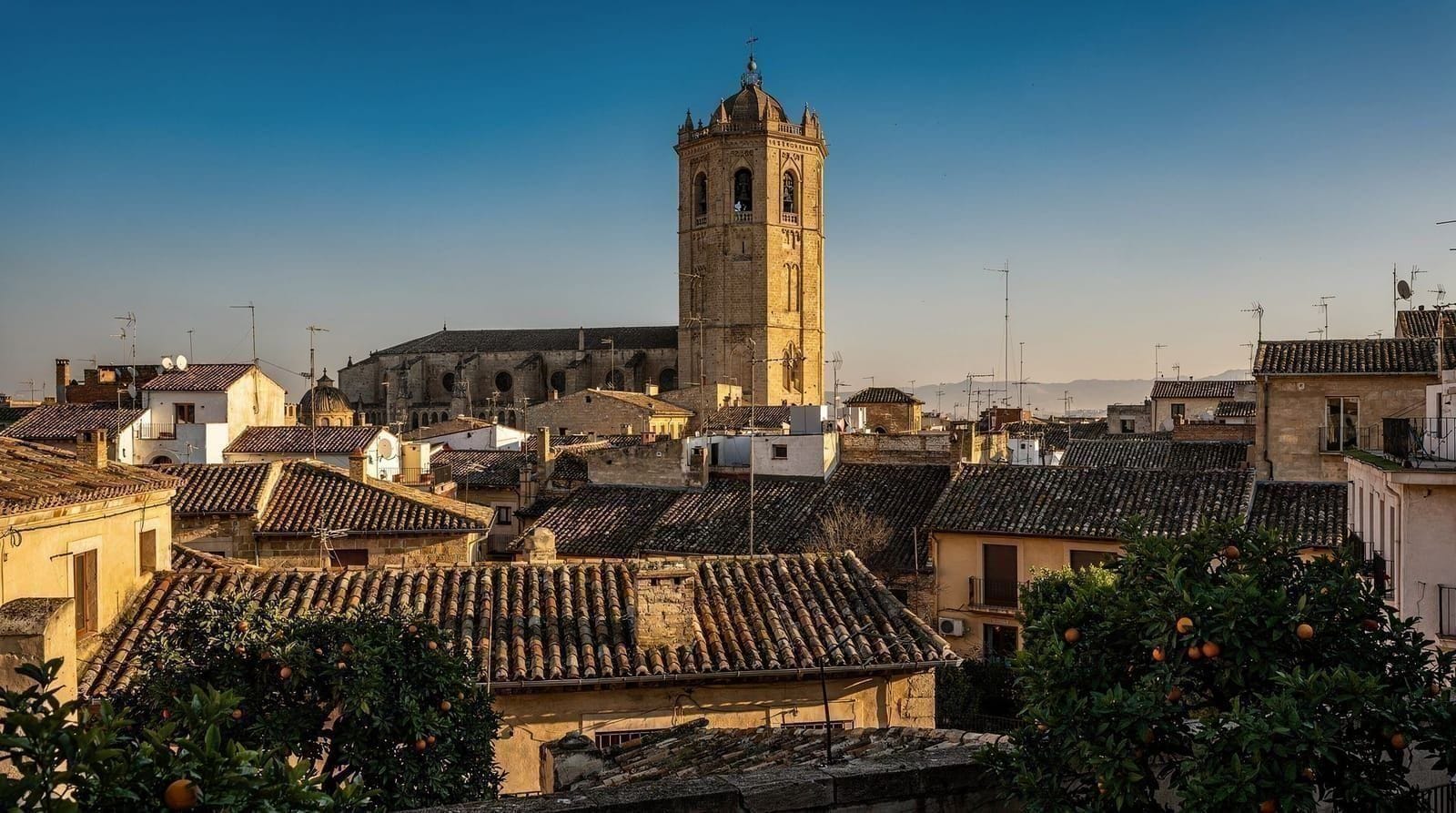
Serranos and Quart towers: Valencia's surviving medieval gates
Valencia: medieval guided walking tour
What are the Torres de Serranos and Torres de Quart in Valencia?
They are the two surviving gates of Valencia's 14th–15th century city walls. The Torres de Serranos (1398) in the north and the Torres de Quart (1460) in the west are the most significant medieval military architecture in Valencia. Entry is €2 each (free Sundays). Both can be visited in one morning.
Of the twelve gates that pierced Valencia’s medieval walls, two survived the wholesale demolition of 1865: the Torres de Serranos to the north and the Torres de Quart to the west. Both were spared by narrow civic votes at a time when most Spanish cities were tearing down their walls to enable 19th-century urban expansion. Both are in remarkable condition, both are accessible to visitors, and both charge €2 — one of the best value experiences in the city.
| Where | Torres de Serranos (north) and Torres de Quart (west), El Carmen |
| Cost | Around €2 each (free on Sundays) |
| Time needed | 1–1.5 hours for both, plus the 15-minute walk between |
| Getting there | Walking distance from the old town; both edge El Carmen |
| Best time | Morning, before the midday heat on the exposed rooftops |
Background: Valencia’s medieval walls
The walls that enclosed Valencia’s medieval city were constructed between 1356 and 1398, prompted by the threat of Castilian invasion during the War of the Two Peters. The circuit ran for approximately 4.5 km, enclosed an area of about 180 hectares, and was punctuated by 12 gates and numerous towers. At completion, the walls enclosed one of the largest cities in Iberian Europe.
The walls survived as a complete defensive circuit until the 19th century, when the Valencia city council voted in 1865 to demolish them as part of a programme of urban modernisation. The demolition vote carried by a majority of one, and a subsequent amendment to preserve the two most impressive gates — Serranos and Quart — carried by the same margin. The stone from the walls was reused in construction throughout the expanding city; the line of the old circuit is still partially traceable in the street pattern.
Torres de Serranos: the northern gate
The Torres de Serranos was built between 1392 and 1398 by the architect Pere Balaguer. It served as the northern gate of the city — the formal entrance for important visitors, royal processions, and merchants arriving from Zaragoza and beyond. The gate was ceremonially significant: the entry of the Aragones king into Valencia traditionally passed through this gate.
Architecture: Two octagonal limestone towers, each rising to about 26 metres, connected by a central battlemented wall with a central archway. The gate faces north across a small plaza and the former riverbed (now the Turia Gardens). The towers are built in the Valencian Gothic style — the same idiom as the Cathedral and the Lonja de la Seda built in the same period.
The interior: The gate interior is a single open ceremonial space on the ground level. The walls are bare stone; the vault is Gothic. Interpretive panels in Spanish and English explain the construction sequence and the gate’s historical role.
The roof: The staircase to the battlemented rooftop is accessible with your ticket. The views from the top take in the Turia Gardens to the north (with the medieval bridges visible along the park), the old city to the south (the Cathedral Miguelete is prominent), and the Fine Arts Museum and Jardines del Real to the northeast.
Prison history: Between the 18th century and 1887, the Torres de Serranos served as the city prison. Prisoners were held in the lower chambers of the gate — you can see carved graffiti from this period on the interior stone. Some inscriptions are dated; the oldest clearly legible ones are from the early 19th century.
Festival use: During Las Fallas, the Torres de Serranos is used as the viewing platform for the Crida ceremony — the official opening of the festival — when the Fallera Mayor (festival queen) addresses the city from the tower battlements. This is one of the most photogenic and culturally significant events of Las Fallas, and the tower is the setting.
Torres de Quart: the western gate
The Torres de Quart (also called Torres de Cuarte) was built between 1441 and 1460, approximately four decades after the Serranos. The architects were Francesc Baldomar and Pere Compte (the same Compte who later designed the Lonja de la Seda). The Quart towers were modelled on the Castel Nuovo in Naples, reflecting Valencia’s political and cultural ties to the Aragonese Kingdom of Naples under Alfonso V.
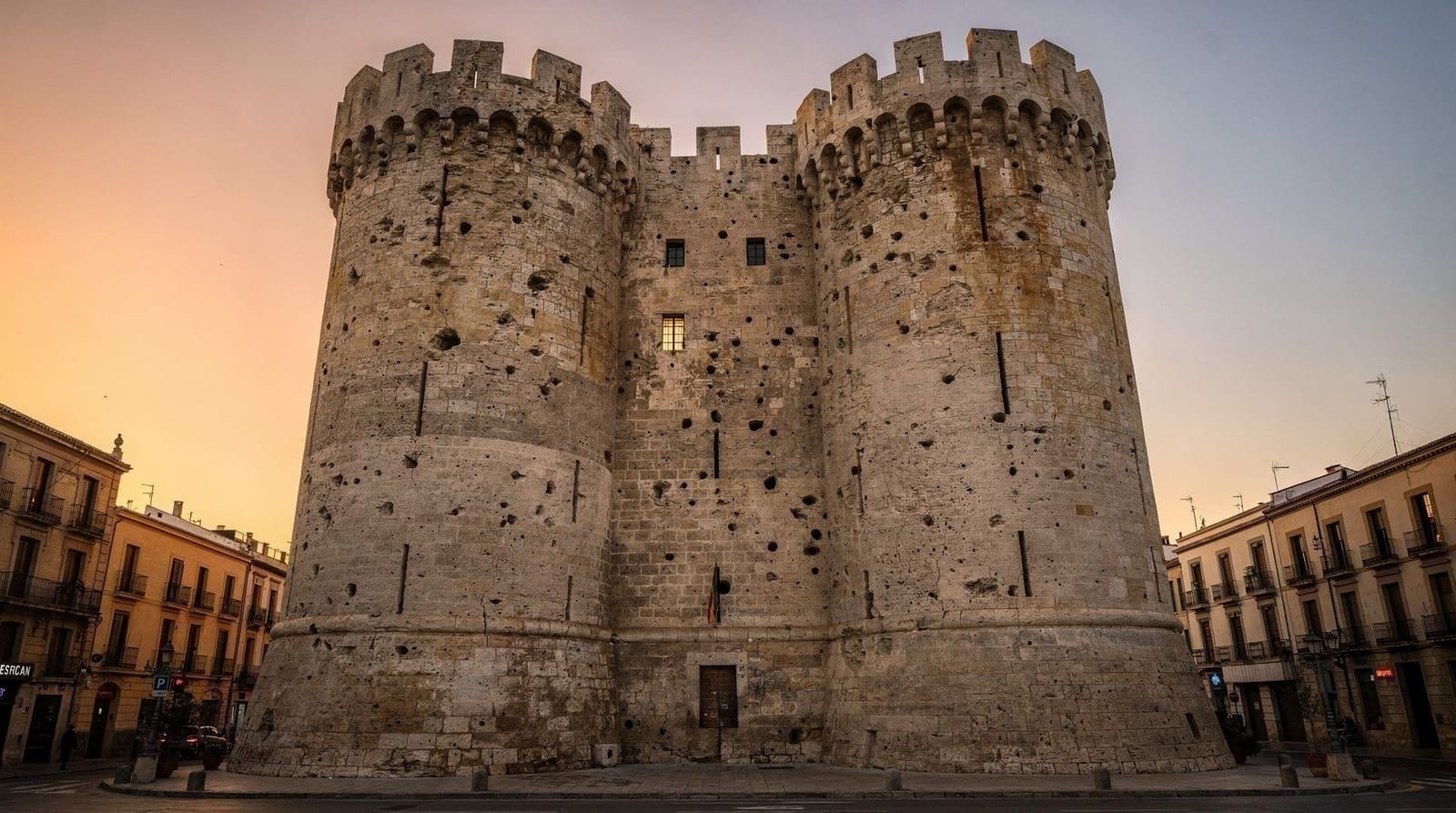
Architecture: Where the Serranos is Gothic and ceremonial, the Quart towers are more massive and military in character. Two large circular towers — significantly heavier in proportion than the Serranos — flank the western gate arch. The towers have crenellated parapets and deep-set windows positioned for defensive shooting.
The bombardment damage: The exterior walls of the Torres de Quart carry clearly visible impact damage. There are two historical layers: large circular holes from the Napoleonic artillery bombardment of 1808 (when French forces besieged Valencia), and smaller modern shrapnel patterns from the Spanish Civil War (1936–39, when Valencia was the seat of the Republican government and subject to Nationalist bombing). The damage was deliberately left unrepaired — a decision formalized in the restoration of the 1980s — as physical evidence of the building’s wartime history. The result is one of the most visually direct examples of conflict archaeology visible to visitors in Spain.
The interior: The Quart towers contain more interpretive content than the Serranos — small display panels on the ground floor cover the history of the city walls, the construction sequence, and the specific history of both sieges that damaged the building. The rooms are accessible on a self-guided basis.
The roof: The rooftop views from the Quart towers face west and north — useful for orientation toward the modern city, the IVAM, and the El Carmen neighbourhood that fills the space between the two towers.
Practical information
Torres de Serranos opening hours:
- Monday–Saturday: 10:00–19:00
- Sunday and public holidays: 10:00–14:00
- Closed 1 and 6 January, 1 May and 25 December
Torres de Quart opening hours:
- Monday–Saturday: 10:00–19:00
- Sunday and public holidays: 10:00–14:00
- Closed 1 and 6 January, 1 May and 25 December
Ticket prices (both):
- Adult: €2 each
- Reduced: €1 each (students, seniors, groups)
- Under 12: free
- Sunday: free for all
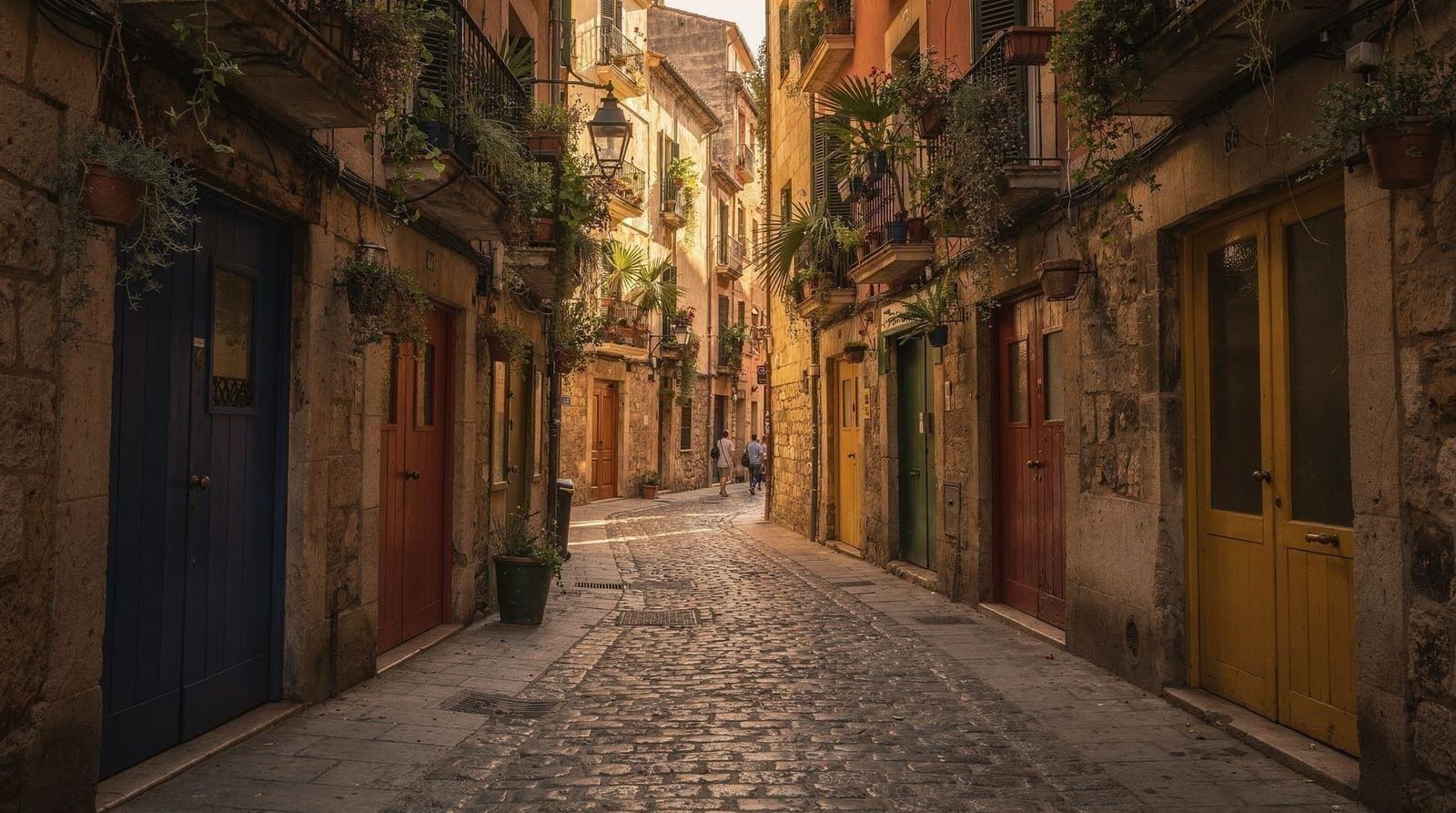
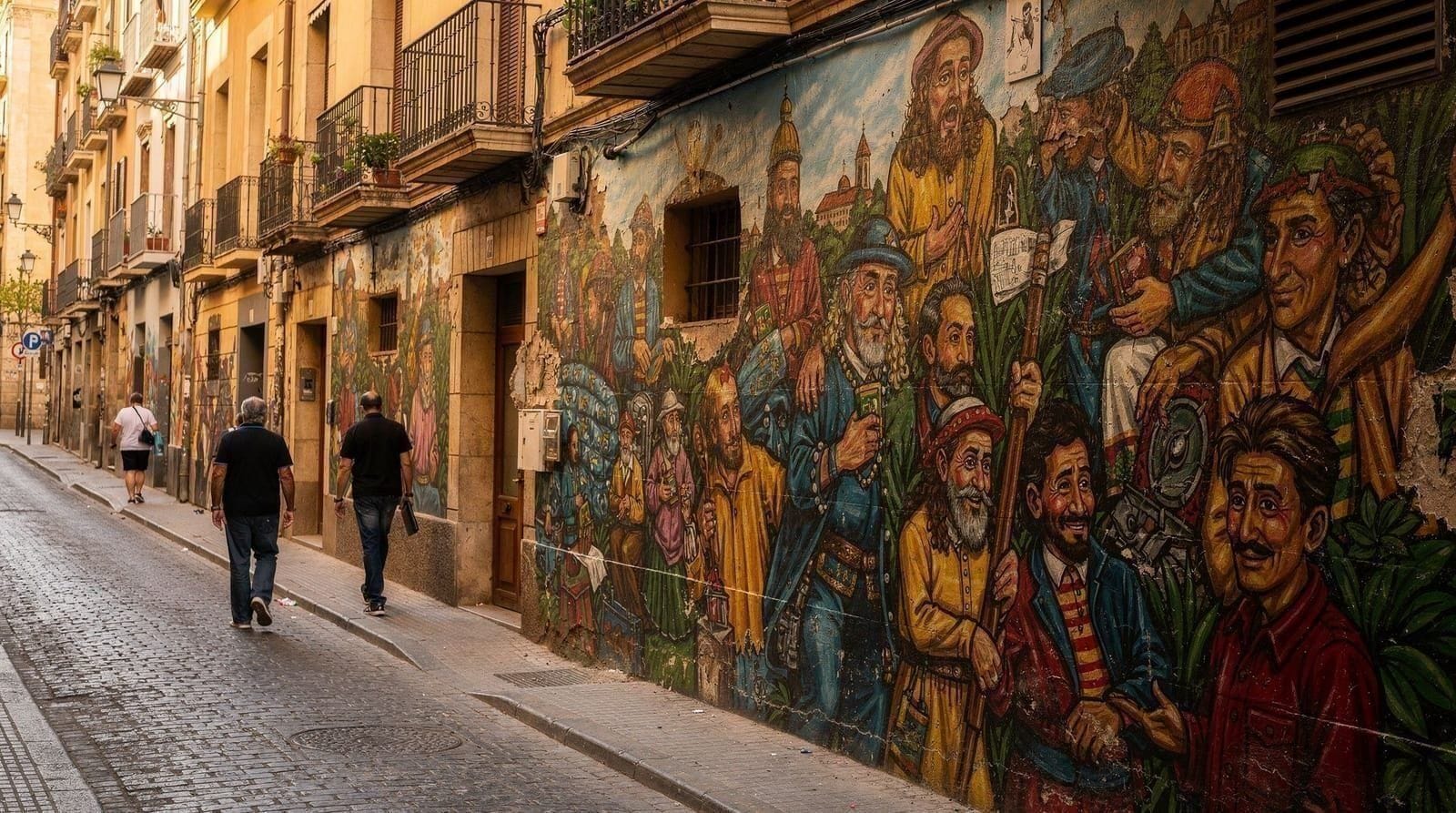
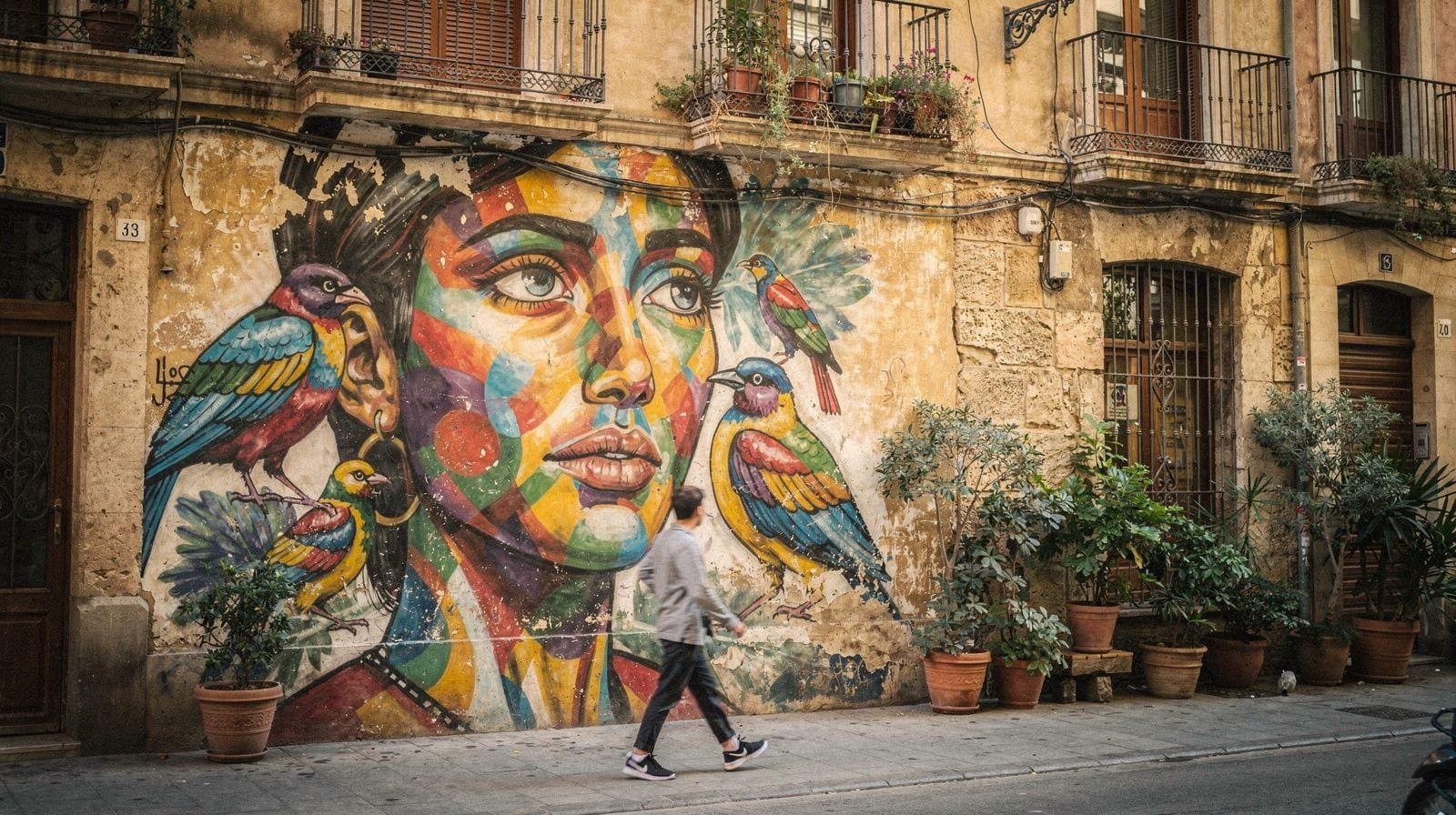
Combined visit: The walk between the two towers along the southern edge of El Carmen takes 15 minutes through streets with notable street art, passing the Carrer dels Cavallers (medieval Knights’ Street) and several historic church facades.
The walk between the two towers
The route between the Serranos and Quart towers along the inner line of the old walls is one of the best 20-minute urban walks in Valencia. Take Carrer de Quart from the Serranos, then turn south on Carrer dels Cavallers — the medieval axis of the Barrio del Carmen, with several of the best examples of 14th–16th century domestic architecture in the city — and arrive at the Quart towers from the east.
This route passes:
- Plaza del Tossal: The central hub of El Carmen, with café terraces
- Carrer dels Cavallers 22: The Palau de Benicarló, a late-medieval palace façade
- Several notable ceramic tile facades characteristic of El Carmen
 medieval guided walking tourCheck availability
Combining with a guided tour
For visitors who want context for the towers’ construction, their role in Valencia’s defensive history, and the broader story of the medieval city walls, a guided El Carmen walking tour provides a framework that the self-guided panels at each tower cannot fully supply.
 historical city tourCheck availability
For the complete context of medieval and historic Valencia — connecting the towers, the Cathedral, the Lonja de la Seda, and the Central Market — see the first weekend in Valencia itinerary and the El Carmen neighbourhood guide.
How to pace the morning
The simplest plan is to start early at the Serranos, climb to the roof while the stone is still cool, then spend the middle of the morning drifting south through El Carmen. There is no need to hurry: the streets between the two gates are the real reason to go on foot, and a coffee stop on the Plaza del Tossal turns the walk into a proper break rather than a transfer. Finish at the Quart towers, and you are close to the lunch options described in the El Carmen neighbourhood guide and the Central Market guide.
If you prefer to visit in the other direction, nothing is lost. Starting at the Quart and ending at the Serranos puts the Turia Gardens at the end of the route, which suits anyone who wants to continue with a stroll or a bike ride along the old riverbed. The Turia Gardens guide and the Valencia by bike guide cover that next step.
What to look for at each gate
At the Serranos, look up before you go in. The two octagonal towers and the battlemented wall between them are best appreciated from the plaza, where the whole composition fits in one frame. Inside, take your time with the bare stone and the vault, then look closely at the carved graffiti left from the prison years: these inscriptions are easy to walk past if you are only heading for the stairs.
At the Quart, the exterior is the main event. Stand back from the gate and let your eye find the circular holes first, then the finer pitting around them. Knowing that two different conflicts left these marks makes the facade easier to read. Inside, the small panels about the walls and the sieges give the damage a context, and they are worth reading before you climb.
On both rooftops, the best habit is to do a slow lap. Each side shows a different layer of the city, and the view changes noticeably between the old town on one side and the park or the modern districts on the other. Bring a hat and water if the day is warm, because the roofs are exposed.
Connecting the towers to the rest of the old town
The two gates make a natural opening or closing chapter for a day in the historic centre. Pair them with the Cathedral and Miguelete tower and the Lonja de la Seda and you have the main strands of Valencian Gothic in a single day: military, civic and religious. The silk route guide explains how the Lonja fits into the city’s commercial story, and the UNESCO Valencia guide sets that heritage in a wider frame.
Visitors who enjoy the street life of El Carmen will also like the street art in El Carmen, which follows many of the same lanes as the walk between the towers. For a wider look at what the old town has to offer, the Ciutat Vella and El Carmen destination page is a good overview. If this is your first trip, the valencia in one day itinerary shows how the towers can slot into a short stay, while the three-day itinerary leaves room to see each gate without rushing.
Families can treat the climb as a small adventure, and the Valencia with kids guide has ideas for balancing a historic morning with something more active in the afternoon. Anyone planning around mobility should check the accessible Valencia guide first, since the rooftops are reached by staircase.
Why the towers still matter
It is easy to treat the gates as photo stops, but they carry a rare continuity. They were built to defend the city, used as a ceremonial entrance, turned into a prison, scarred by war, and now serve as open museums. Few buildings in Valencia show so many chapters of the city’s story in so little space. For travellers who like to understand a place rather than just tick it off, an hour at each gate pays back more than the modest fee suggests. If you want even more background on the city’s past, the Valencia travel guides for museums and sights and the Fine Arts Museum guide make good companions, and the Valencia tourist card guide can help you decide how to bundle attractions.
Which tower to prioritise if you are short on time
If you only have time for one tower, the choice depends on what interests you. The Serranos is more architecturally refined — Gothic, ceremonial, and the setting for the Fallas Crida each March — and its interior graffiti from its prison-era history adds a layer most visitors do not expect. The Quart is more visually dramatic from outside, with its unrepaired bombardment scars offering an unusually direct, physical link to two very different conflicts three centuries apart. For photography, the Quart’s western facade catches better light in late afternoon; for the best rooftop panorama of the old town, the Serranos wins because of its position facing directly across the Turia Gardens toward the Cathedral.
Combining the towers with a Fallas visit
Visitors in Valencia during Las Fallas should note that the Torres de Serranos plays a specific ceremonial role — it is where the Crida, the festival’s official opening address, takes place from the battlements. Outside festival dates, the towers are calm and largely free of crowds, making March a good time to combine a Fallas trip with an unhurried visit, provided you check for temporary access restrictions around the Crida date itself.
Top experiences
Bookable activities with verified prices and instant confirmation on GetYourGuide.